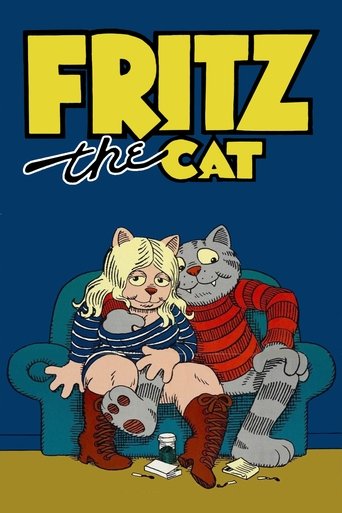
Fritz the Cat (1972)
We're not rated X for nothin', baby!
In late 1960s New York City, fed up with monotonous college life and police repression, free-spirited Fritz, an impenitent seducer and unrestrained party-animal, decides to explore the world. And just like that, as he flees NYC, heading to San Francisco, Fritz embarks on an endless adventure of illumination. Immersed in a world surrounded by drugs and sex, Fritz participates in mad orgies, brings about a revolution, incites mass urban riots, and crosses paths with drug-addled Nazi bikers.
- Date of release
- 1972-04-14
- TMDB
- 6.2 / 10 (410)
- Runtime
- 1h 18m
- Genres
- Animation, Comedy, Drama
- Director
- Ralph Bakshi
- Collection
- Fritz the Cat Collection
Casting
- Skip Hinnant — Fritz (voice)
- Rosetta LeNoire — Bertha / Additional Female Crows (voice)
- John McCurry — Blue / John / Additional Voices (voice)
- Phil Seuling — Pig Cop #2 (voice)
- Judy Engles — Winston Schwartz / Lizard Leader (voice)
- Ralph Bakshi — Narrator / Pig Cop #1 (voice)
- Mary Dean — Girl #1 / Girl #2 / Girl #3 / Harriet (voice)
- Charles Spidar — Bar Patron / Duke the Crow (voice)
Interesting facts
- Budget: $700K
- Based on: Fritz the Cat
Fritz the Cat is a 1972 American Independent adult animated black comedy film written and directed by Ralph Bakshi in his directorial debut. Based on Robert Crumb's comic strip of the same name, the film focuses on its Skip Hinnant–portrayed titular character, a glib, womanizing and fraudulent cat in an anthropomorphic animal version of New York City during the mid-to-late 1960s. Fritz decides on a whim to drop out of college, interacts with inner city African American crows, unintentionally starts a race riot and becomes a leftist revolutionary.
Production
While browsing the East Side Book Store on St. Mark's Place in New York City, Bakshi discovered a copy of R. Crumb's Fritz the Cat (1969). Impressed by Crumb's sharp satirical tone, Bakshi purchased the comic book and later proposed to Krantz that it could be adapted into a feature film. Convinced that Crumb's creative sensibility aligned with his own, Bakshi expressed interest in directing the adaptation.
As development continued, a pitch package was assembled that included a painted cel composited over a photographic background to illustrate Bakshi's intended visual approach. Although Crumb initially responded positively, he ultimately declined to sign a formal agreement due to uncertainty about the project's direction.
In spring 1970, Warner Bros. agreed to finance and distribute the project, providing Bakshi and Krantz with their first major studio backing. Early on its production, the Harlem sequence was the first to be completed. Krantz even considered releasing this material as a standalone 15-minute short if financing fell through, although Bakshi remained committed to completing a full feature.
Warner Bros. subsequently requested that the sexual content be reduced and insisted on the inclusion of recognizable actors. When Bakshi refused to make these changes, the studio withdrew their financial support, forcing Krantz to seek alternative funding sources.
Bakshi was initially hesitant to direct Fritz the Cat, as he had already spent much of his career animating anthropomorphic animals and had hoped to move toward films focused primarily on human subjects. Nevertheless, he was attracted to the project because of his strong admiration for Crumb's work, which he regarded as a "total genius".
Read on Wikipedia · Text from Wikipedia, CC BY-SA 4.0. Data from Wikidata.
Recommended
- Heavy Traffic 1973 · ★ 6.5
- South Park (Not Suitable for Children) 2023 · ★ 7.5
- Kinds of Kindness 2024 · ★ 6.5
- The Clique 2008 · ★ 5.9
- Hooking Up 2020 · ★ 6.3
- For a Good Time, Call... 2012 · ★ 5.8
- In the Soup 1992 · ★ 6.8
- Dope 2015 · ★ 7.0
- Beyond the Valley of the Dolls 1970 · ★ 6.1
- Happiness 1998 · ★ 7.4
- Family Weekend 2013 · ★ 6.3
- Fear and Loathing in Las Vegas 1998 · ★ 7.2