The Garden of Earthly Delights (1981)
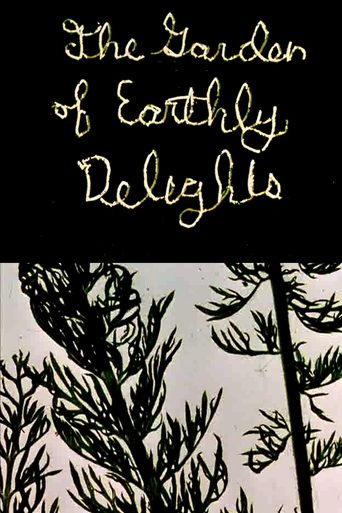
A collage of two-dimensional images of vegetation, each appearing only for a moment, sometimes as a single image, more often with other bits of stem, leaf, bud, or petal. Often we see only the outline of objects against a black background. Black and green are occasionally joined by fragments of orange or of white and blue. The objects in the frame don't move but they are quickly replaced by another collage, giving the feel of rapid motion. Each collage is crisp, its lines etched against the background of black and later of white. Whitman anyone, or Hieronymus Bosch? Although there is no soundtrack, the rapidity of changing images and colors suggests a riot.
- Дата выхода
- 1981-01-01
- TMDB
- 6.1 / 10 (46)
- Длительность
- 2 мин
- Жанры
- мультфильм
- Режиссёр
- Stan Brakhage
Интересные факты
The Garden of Earthly Delights is an experimental short film by Stan Brakhage, released in 1981. The film was partly inspired by Hieronymus Bosch’s painting of the same name.
Production
The Garden of Earthly Delights, like Brakhage's earlier Mothlight, is considered a "collage film." It was created without the use of a camera, by pasting montane zone vegetation, such as petals, grasses and leaves, onto strips of clear film leader. Brakhage intended the film as "an homage to (but also argument with) Hieronymous Bosch."
At the time I made The Garden [of Earthly Delights], I was very annoyed with Hieronymus Bosch’s painting of the same name, which envisions nature as puffy and sweet, while the humans are suffering these torments. After all, nature suffers as well. As a plant winds itself around, in its desperate reach for sunlight, it undergoes its own torments. We are not the only ones in the world.Brakhage has also cited as inspiration J.E.H.
The Garden of Earthly Delights was produced on 16mm film, and is intended to be screened at 18 frames per second; however, this is not possible for many 16mm projectors. The film runs for a total of 2,496 frames. Like Bosch's triptych, Brakhage's film is divided into three sections using alternating black and white leader backgrounds.
Читать в Википедии · Текст из Википедии, CC BY-SA 4.0. Данные Викиданных.
Рекомендуем
- Стерджил Симпсон представляет: Sound & Fury 2019 · ★ 6.1
- Этот дом 2022 · ★ 7.0
- Кунг-фу Панда: Секреты мастеров 2011 · ★ 6.5
- Ночь анимационных мертвецов 2021 · ★ 6.1
- Убить Боба 2008 · ★ 7.2
- Пророк 2014 · ★ 7.4
- Коати. Легенда джунглей 2021 · ★ 7.1
- Super Monsters: Once Upon a Rhyme 2021 · ★ 6.1
- Шрэк: Триллер 2011 · ★ 6.8
- L.O.L. Surprise! Winter Fashion Show 2022 · ★ 7.8
- Время мелодий 1948 · ★ 6.1
- The Wonderful World of Mickey Mouse: Steamboat Silly 2023 · ★ 6.9