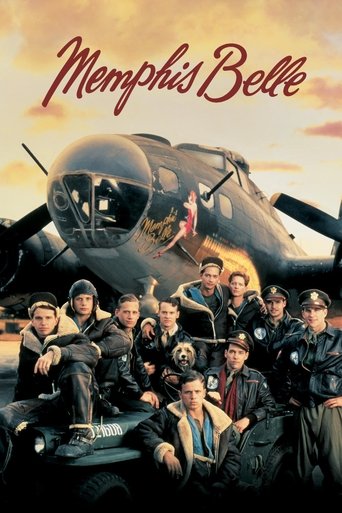
Memphis Belle (1990)
Brave young men who rode on the wings of victory.
The "Memphis Belle" is a World War II bomber, piloted by a young crew on dangerous bombing raids into Europe. The crew only have to make one more bombing raid before they have finished their duty and can go home. In the briefing before their last flight, the crew discover that the target for the day is Bremen.
- Date of release
- 1990-09-07
- TMDB
- 6.8 / 10 (463)
- Runtime
- 1h 47m
- Genres
- Drama, War, Action
- Director
- Michael Caton-Jones
Casting
- Matthew Modine — Dennis Dearborn
- Eric Stoltz — Danny Daly
- Tate Donovan — Luke Sinclair
- D. B. Sweeney — Phil Lowenthal
- Billy Zane — Val Kozlowski
- Sean Astin — Richard "Rascal" Moore
- Harry Connick Jr. — Clay Busby
- Bradley Lavelle — Sergeant
- Reed Diamond — Virgil Hoogesteger
- Courtney Gains — Eugene McVey
- Neil Giuntoli — Jack Bocci
- David Strathairn — Craig Harriman
Interesting facts
- Box office: $27.4M
- Budget: $23M
- Earned 1.2× its budget
- Filmed in: Pinewood Studios
Memphis Belle is a 1990 war drama film directed by Michael Caton-Jones and written by Monte Merrick. The film stars Matthew Modine, Eric Stoltz, and Harry Connick Jr.. Memphis Belle is a fictional version of the 1944 documentary Memphis Belle: A Story of a Flying Fortress by director William Wyler, about the 25th and last mission of an American Boeing B-17 Flying Fortress bomber, the Memphis Belle, based in England during World War II. The 1990 version was co-produced by David Puttnam and Wyler's daughter Catherine and dedicated to her father. The film closes with a dedication to all airmen, friend or foe, who fought in the skies above Europe during World War II.
Production
Five real B-17 warbirds were used in the filming of Memphis Belle, out of eight B-17s that were airworthy during the late 1980s. Two were located in the United States (N3703G and N17W), two were in France (F-BEEA, which was destroyed in a takeoff accident and F-AZDX The Pink Lady), and one was in England (G-BEDF Sally B). N17W is currently on static display at Museum of Flight in Tukwila, WA.
Ground sequences for the movie (including takeoff and landing scenes) were filmed at the non-operational RAF Binbrook in Lincolnshire, England with a period control tower and vehicles being placed on site. Flying sequences were flown from the airfield site of the Imperial War Museum Duxford. All the extras for the film were obtained from auditions held in the area and included current and former members of the Royal Air Force.
A North American B-25 Mitchell was used to film the majority of the aerial scenes with several fixed and trainable cameras also mounted on the available B-17s and fighter aircraft for action shots. A Grumman TBM Avenger (with its tail section painted the same olive drab tones used on the B-17s) was used as back-up for a short time when the B-25 became unserviceable during filming.
The film pilots were warbird display pilots coming from the UK, USA, France, Germany, New Zealand and Norway, the roster changing several times as pilots had to return to their full-time jobs during filming. The flying sequences were devised and planned under the coordination of Old Flying Machine Company (OFMC) pilots Ray Hanna and his son Mark, who also acted as chief pilots for the fighter aircraft used and flew the camera-equipped fighter and…
Due to a shortage of actual B-17 airframes, wooden silhouette mock-ups were made and placed at distant parts of the airfield.
Read on Wikipedia · Text from Wikipedia, CC BY-SA 4.0. Data from Wikidata.
Recommended
- Hell's Angels 1930 · ★ 6.6
- The Blue Max 1966 · ★ 6.8
- Flyboys 2006 · ★ 6.5
- Strategic Air Command 1955 · ★ 6.1
- The Purple Plain 1954 · ★ 6.5
- U-571 2000 · ★ 6.6
- Patton 1970 · ★ 7.4
- Aces High 1976 · ★ 5.9
- Ice Cold in Alex 1958 · ★ 7.3
- The Longest Day 1962 · ★ 7.6
- Operation Pacific 1951 · ★ 6.1
- Overlord 1975 · ★ 6.8