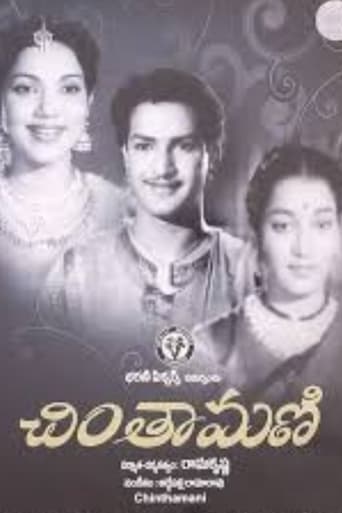
చింతామని (1956)
Chintamani, a courtesan, is a devotee of Lord Vishnu. Her strong faith impresses Lord Vishnu and he decides to help her with her problems.
- Date de sortie
- 1956-04-11
- TMDB
- 9.0 / 10 (1)
- Durée
- 2 h 28 min
- Genres
- Drame, Musique
- Réalisateur
- P. S. Ramakrishna Rao
Distribution
- Bhanumathi — Chintamani
- N.T. Rama Rao — Bilwamangaludu
- Jamuna — Radha
- S. V. Ranga Rao — Bhavani Shankarudu
- Relangi Venkata Ramaiah — Subbi Shetty
- Raghuramaiah — Lord Krisha
- Rushyendramani — Srihari
Anecdotes
Chintamani is a 1956 Indian Telugu-language drama film produced and directed by P. S. Ramakrishna Rao. It stars P. Bhanumathi, N. T. Rama Rao and Jamuna, with music composed by Addepalli Rama Rao and T. V. Raju. The film is based on the play of the same name, written by Kallakuri Narayana Rao. It was a flop at the box office.
Production
Chintamani was produced by P. Bhanumathi under her production company, Bharani Pictures, and directed by her husband, P. S. Ramakrishna Rao. The film starred N. T. Rama Rao in the lead role of Bilvamangaludu, with Bhanumathi playing the title role of Chintamani.
Initially, Akkineni Nageswara Rao was considered for the role of Bilvamangaludu. However, Nageswara Rao declined the role, advising the producers to abandon the project, suggesting that Bharani Pictures was not suitable for such a film. Despite this setback, Bhanumathi and Ramakrishna chose to proceed with the project, as the script work had already been completed.
The production featured S. V. Ranga Rao as Bhavani Sankarudu and Relangi as Subbi Setti. Since Bhanumathi was playing the role of Chintamani, the filmmakers took precautions to maintain her public image by portraying the character as a devout woman, refraining from any depiction that could be seen as tarnishing her persona. As a result, the character was reimagined as a devoted follower of Lord Krishna rather than a seductive figure.
Director Ramakrishna aimed to present the film with a serious and dignified tone, deliberately avoiding light-hearted or comedic treatment. However, despite these efforts, the film did not meet the audience’s expectations. Viewers, who had anticipated a more entertaining narrative, were disappointed by the sombre tone of the film.
The film was adapted from the play Chintamani by Kallakuri Narayana Rao. However, government censorship imposed restrictions on certain scenes, particularly those between Chintamani and Subbi Setti, which were removed during the editing process. In an attempt to add more entertainment, Ramakrishna included comedic scenes between Subbi Setti and his wife, but these too were censored.
Lire sur Wikipédia · Texte de Wikipédia, CC BY-SA 4.0. Données de Wikidata.
Recommandés
- Grace Unplugged 2013 · ★ 6.0
- La Ballade des sans-espoir 1961 · ★ 6.4
- Honeydripper 2007 · ★ 5.9
- Dance with me 2006 · ★ 6.9
- Spin, pour l'amour de la musique 2021 · ★ 6.9
- La Boîte à musique 1946 · ★ 5.8
- Skater Girl 2021 · ★ 7.2
- Good Vibrations 2012 · ★ 6.7
- Let It Shine 2012 · ★ 7.0
- The Last Rifleman 2023 · ★ 6.6
- Oranges and Sunshine 2010 · ★ 6.9
- Like Sunday, Like Rain 2014 · ★ 7.4