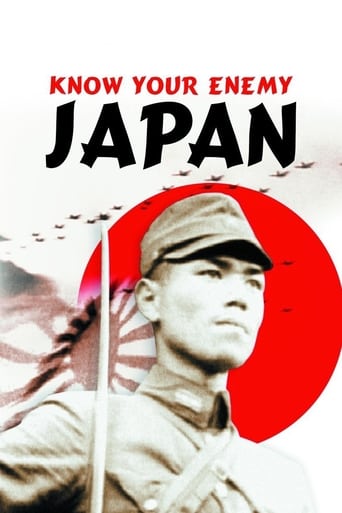
Know Your Enemy: Japan (1945)
Frank Capra-directed propaganda film produced during World War II depicting the United States' new enemy: Japan.
- Date of release
- 1945-08-09
- TMDB
- 5.9 / 10 (18)
- Runtime
- 1h 3m
- Genres
- Documentary, War, History
- Director
- Frank Capra
Casting
- John Beal — Narrator
- Howard Duff — Narrator
- Walter Huston — Narrator
- Knox Manning — Narrator
Interesting facts
Know Your Enemy: Japan is an American World War II propaganda film about the war in the Pacific directed by Frank Capra, with additional direction by experimental documentary filmmaker Joris Ivens. The film, which was commissioned by the U.S. War Department, sought to educate American soldiers about Japan, its people, society and history, and its totalitarian militaristic government. However, the film never realized its full purpose because its completion was delayed by disputes between Hollywood and Washington, and the abrupt end of the Pacific War soon after the film's release in August 1945. The film's first public screening was in 1977 as part of a PBS special.
Production
When the U.S. entered World War II, Army Chief of Staff George C. Marshall made an official request to the director Frank Capra for the production of a series of documentary films to be released to the general public and used for the orientation of American soldiers before and during deployment.
Although production on Know Your Enemy: Japan began in 1942, it was troubled from the very beginning by the inability of the U.S. government to determine what exactly the foreign policy towards Japan should be.
Warren Duff wrote the first screenplay for the film in June 1942, but it was shelved when the Army General Staff moved to Los Angeles. Frank Capra hired Joris Ivens to supervise the documentary in early 1943, but after Ivens submitted a 20-minute preview, which treated the Japanese as an open-minded people being led by a vilified Emperor Hirohito, Capra told Ivens to leave the project because the U.S.
Edgar Peterson and John Huston were initially considered to direct the film before Capra and Ivens themselves took the role.
Eventually the scriptwriters felt Capra had lost direction in the film, apart from his desire to give the film racist overtones. The writers did not know that Capra's racist depictions were at the request of the U.S. military. In January 1945, the film underwent a series of final revisions because The Pentagon thought it still had "too much sympathy for the Jap people."
Read on Wikipedia · Text from Wikipedia, CC BY-SA 4.0. Data from Wikidata.
Recommended
- The Soviet Story 2008 · ★ 7.3
- The Battle of San Pietro 1945 · ★ 6.1
- Why We Fight: Prelude to War 1942 · ★ 6.4
- 2000 Meters to Andriivka 2025 · ★ 8.1
- WWII From Space 2012 · ★ 7.4
- Father Soldier Son 2020 · ★ 6.5
- The Age of Stupid 2009 · ★ 6.6
- They Shall Not Grow Old 2018 · ★ 7.8
- Let There Be Light 1946 · ★ 7.3
- Korengal 2014 · ★ 6.6
- The Kill Team 2013 · ★ 6.9
- For Sama 2019 · ★ 8.2