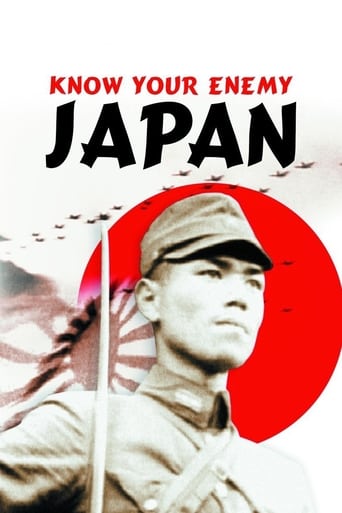
认识你的敌人:日本 (1945)
Know Your Enemy: Japan
在这个流光溢彩的历史画卷中,我们不禁想起那部充满情感和人性光辉的美国宣传片,《认识你的敌人日本》。这部电影是弗兰克·卡普拉执导的,承载着美国战争部的厚望。然而,在光芒闪耀之前,它经历了好莱坞制片人与华盛顿之间的争执,这一矛盾延误了它的完成。这部电影的初衷是让美国士兵在战火纷飞的太平洋战场上,为战争做好充分准备,以面对未知的危险与挑战。这是一份对爱国心的呼唤,是一次对士兵们的深情关怀。这个使命驱使着导演弗兰克·卡普拉,他的眼中充满了对国家的热爱和对和平的渴望。 电影的诞生充满了挫折,但它的每一帧都闪烁着坚韧和信念的火花。片中充满了对日本文化的深入探索,如同一次穿越时光的旅程,展现出了日本人民的生活、传统和价值观。情感在镜头中绽放,让观众更深入地了解了曾经的敌人。然而,命运的轮回总是充满戏剧性,电影完成后不久,战争突然结束,美国士兵最终没有前往太平洋。这部电影成为了历史的一页,但它永远铭刻在人们的心中,作为一段对和平的渴望和对人性的探寻。《认识你的敌人日本》是一部蕴含着情感和人性的史诗,它以其深刻的观察和情感充沛的表达,让我们更深刻地了解了那个时代和那个国家。 它告诉我们,即使在战争的硝烟中,人性和情感依然闪烁不灭,带着希望和梦想,追求着和平的光芒。
演员阵容
趣闻
Know Your Enemy: Japan is an American World War II propaganda film about the war in the Pacific directed by Frank Capra, with additional direction by experimental documentary filmmaker Joris Ivens. The film, which was commissioned by the U.S. War Department, sought to educate American soldiers about Japan, its people, society and history, and its totalitarian militaristic government. However, the film never realized its full purpose because its completion was delayed by disputes between Hollywood and Washington, and the abrupt end of the Pacific War soon after the film's release in August 1945. The film's first public screening was in 1977 as part of a PBS special.
Production
When the U.S. entered World War II, Army Chief of Staff George C. Marshall made an official request to the director Frank Capra for the production of a series of documentary films to be released to the general public and used for the orientation of American soldiers before and during deployment.
Although production on Know Your Enemy: Japan began in 1942, it was troubled from the very beginning by the inability of the U.S. government to determine what exactly the foreign policy towards Japan should be.
Warren Duff wrote the first screenplay for the film in June 1942, but it was shelved when the Army General Staff moved to Los Angeles. Frank Capra hired Joris Ivens to supervise the documentary in early 1943, but after Ivens submitted a 20-minute preview, which treated the Japanese as an open-minded people being led by a vilified Emperor Hirohito, Capra told Ivens to leave the project because the U.S.
Edgar Peterson and John Huston were initially considered to direct the film before Capra and Ivens themselves took the role.
Eventually the scriptwriters felt Capra had lost direction in the film, apart from his desire to give the film racist overtones. The writers did not know that Capra's racist depictions were at the request of the U.S. military. In January 1945, the film underwent a series of final revisions because The Pentagon thought it still had "too much sympathy for the Jap people."
在维基百科阅读更多 · 文本来自维基百科,CC BY-SA 4.0。数据来自 Wikidata。