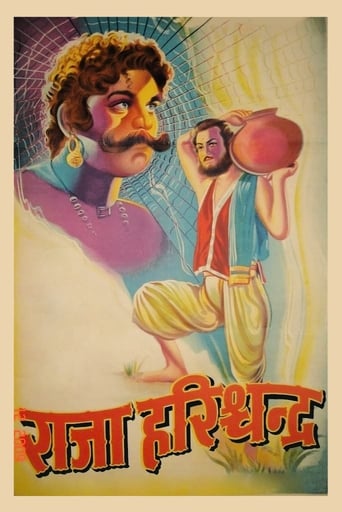
Raja Harishchandra (1913)
राजा हरिश्चंद्र
Revolves around the noble and righteous king, Harishchandra, who first sacrifices his kingdom, followed by his wife and eventually his children to honor his promise to the sage Vishwamitra.
- Date of release
- 1913-04-21
- TMDB
- 5.0 / 10 (14)
- Runtime
- 40m
- Genres
- History, Drama
- Director
- Dhundiraj Govind Phalke
Casting
- D.D. Dabke — Raja Harishchandra
- P.G. Sane — Taramati
- Bhalachandra D. Phalke — Rohitas
- G.V. Sane — Vishwamitra
- Dattatreya Kshirsagar
- Dattatreya Telang
- Ganpat G. Shinde
- Vishnu Hari Aundhkar
- Anna Salunke
- Nath T. Telang
Interesting facts
Raja Harishchandra is a 1913 Indian silent film directed and produced by Dadasaheb Phalke. It is often considered the first full-length Indian feature film. Raja Harishchandra features Dattatraya Damodar Dabke, Anna Salunke, Bhalchandra Phalke and Gajanan Vasudev Sane. It is based on the legend of Harishchandra, with Dabke portraying the title character. The film, being silent, had English, Marathi, and Hindi-language intertitles.
Production
On 14 April 1911, Dadasaheb Phalke with his elder son Bhalchandra went to see a film, Amazing Animals, at the America India Picture Palace, Girgaon. Surprised at seeing animals on the screen, Bhalchandra informed his mother, Saraswatibai, about his experience. None of the family members believed them, so Phalke took his family to see the film the next day.
During his London trip, Phalke had placed an order for a Williamson camera and Kodak raw films and a perforator which reached Bombay (now Mumbai) in May 1912. He set up a processing room and taught his family to perforate and develop the film. Though Phalke was certain of his idea of filmmaking, he could not find any investors. So, he decided to make a short film to demonstrate the techniques.
In his Marathi language magazine Suvarnamala, Phalke had published a story Surabaichi Kahani (A Tale of Sura). The story, which depicted the ill effects of alcoholism, was the first he considered for filming. After watching several American films screened in Bombay, he observed that they included mystery and romance, which the audiences liked.
After considering various stories depicted in Hindu mythology, Phalke's family shortlisted the legends of Krishna, Savitri and Satyavan, and Harishchandra. At the time, a play based on the legends of Harishchandra was popular on Marathi and Urdu stages. Friends and neighbours had often called Phalke "Harishchandra" for having sold all his belongings, except his wife's mangala sutra, to fulfil his filmmaking dream.
Phalke published advertisements in various newspapers like Induprakash calling for the cast and crew required for the film. It was well-received and huge number of applicants came in for the auditions. Despite a growing response to the advertisement, he was not satisfied with the performers' skills. He discontinued the advertisements and decided to scout for the artists through theatre companies.
Read on Wikipedia · Text from Wikipedia, CC BY-SA 4.0. Data from Wikidata.
Recommended
- Outlaws - For Greater Glory 2012 · ★ 7.0
- Mr. Turner 2014 · ★ 6.6
- Firebrand 2024 · ★ 6.3
- A Month in the Country 1987 · ★ 6.5
- Prizefighter: The Life of Jem Belcher 2022 · ★ 6.2
- The Hill 2023 · ★ 7.7
- Mary 2024 · ★ 6.3
- All Eyez on Me 2017 · ★ 6.7
- I Am Elizabeth Smart 2017 · ★ 6.8
- Girl in the Box 2016 · ★ 6.7
- The Last Rifleman 2023 · ★ 6.6
- Worth 2021 · ★ 6.7