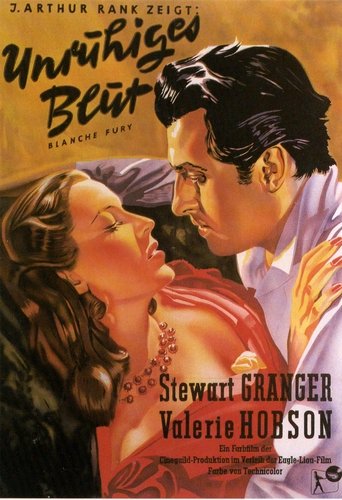
Unruhiges Blut (1948)
Blanche Fury
England, mitte des vorigen Jahrhunderts. Die bildschöne, aber berechnende Blanche lebt in ärmlichen Verhältnissen. Als sie von ihrem Onkel nach Clare Hall eingeladen wird, einem vornehmen und beeindruckenden Herrenhaus, wendet sich ihr Schicksal. Blanches ehrgeizige Pläne scheinen in Erfüllung zu gehen, als der Sohn ihres Onkels um ihre Hand anhält. Sie willigt in die Heirat ein, obwohl ihr unruhiges Blut sie längst in die Arme des gutaussehenden, gewissenlosen Philip Thorn getrieben hat. Der Gutsverwalter ist ein illegitimer Nachkomme der Familie. Blanche weiß nicht, daß Philip besessen ist von dem Gedanken, der wahre Herr von Clare Hall zu werden.
- Erscheinungsdatum
- 1948-02-19
- TMDB
- 6.2 / 10 (25)
- Laufzeit
- 1 Std. 38 Min.
- Genres
- Drama, Thriller, Liebesfilm
- Regie
- Marc Allégret
Besetzung
- Valerie Hobson — Blanche Fury
- Stewart Granger — Philip Thorn
- Michael Gough — Lawrence Fury
- Walter Fitzgerald — Simon Fury
- Susanne Gibbs — Lavinia Fury
- Maurice Denham — Major Fraser
- Sybille Binder — Louisa
- Ernest Jay — Samuel Calamy
- Townsend Whitling — Banks
- J.H. Roberts — Doctor
- Allan Jeayes — Mr. Weatherby
- Edward Lexy — Colonel Jenkins
Wissenswertes
- Basiert auf: Blanche Fury
- Gedreht in: Pinewood Studios
Blanche Fury is a 1948 British Technicolor drama film directed by Marc Allégret and starring Valerie Hobson, Stewart Granger and Michael Gough. It was written by Audrey Erskine Lindop, Cecil McGivern and Hugh Mills adapted from the 1939 novel of the same title by Joseph Shearing. In Victorian era England, two schemers will stop at nothing to acquire the Fury estate, even murder. The plot is based on the Stanfield Hall slayings, an actual contemporary homicide case.
Production
Star Valerie Hobson was married to producer Anthony Havelock-Allan. She later recalled "I had just had our son, who was born mentally handicapped, and he meant the film as a sort of 'loving gift', making me back into a leading lady, which was a wonderful idea. The film didn't work completely."
The film was announced in September 1946. (Shortly afterwards 20th Century Fox announced they would make a film from another Shearing novel, Moss Rose.) Stewart Granger, then one of the biggest stars in British films, signed to co-star and Marc Allégret was to direct.
Filming started in January 1947 at Pinewood Studios. The stately home used in the exterior shots is Wootton Lodge in Staffordshire. The courtroom scenes were filmed in the Shire Hall at Stafford. The location scenes for the film were shot at Wootton Lodge (which stood in for Clare Hall in the story), a magnificent three-storey Georgian mansion at Upper Ellastone on the Derbyshire–Staffordshire border and on the surrounding Weaver Hills, as well a…
Granger later said the film "was a silly story, too grim and melodramatic, but it's a wonderful looking film... I enjoyed working with Valerie Hobson, but the film didn't work."
Havelock-Allan later said he felt the most exciting aspect of the story was the murder being committed by a "gypsy woman" who was actually a man. However, he says: "Stewart Granger refused to play it dressed as a woman, even though you would only have seen a flash of him, so it lost that high point scene."
Auf Wikipedia weiterlesen · Text aus Wikipedia, CC BY-SA 4.0. Daten aus Wikidata.
Empfohlen
- Cavemans Valentine - Tod eines Engels 2001 · ★ 5.9
- Die toten Augen von London 1961 · ★ 6.1
- Islands 2025 · ★ 6.1
- Die Strohpuppe 1964 · ★ 6.2
- Moonlight Mile 2002 · ★ 6.3
- Der Tiger von New York 1955 · ★ 6.3
- The Parts You Lose 2019 · ★ 6.6
- Das Haus in der Carroll Street 1988 · ★ 6.0
- Zwischen Haß und Liebe 1955 · ★ 7.0
- Der erste Blick, der letzte Kuss und alles dazwischen 2022 · ★ 6.1
- Besessen 2002 · ★ 6.0
- Gosford Park 2001 · ★ 6.8