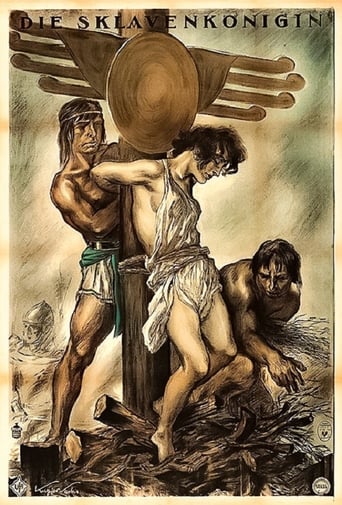
Die Sklavenkönigin (1924)
A Jewish slave girl falls in love with the Pharaoh's son during the Exodus.
- Data de estreia
- 1924-10-25
- TMDB
- 6.8 / 10 (6)
- Duração
- 2 h 24 min
- Géneros
- Drama
- Realizador
- Michael Curtiz
Elenco
- María Corda — Merapi, The Moon of Israel
- Adelqui Migliar — Prince Seti
- Arlette Marchal — Userti
- Ferdinand Onno — Poet Ana
- Oscar Beregi Sr. — Amenmeses
- Henry Mar — Moses
- Adolf Weisse — Pharaoh Menapta
- Reinhold Häussermann — Pampasa
- Georges Haryton — Laban
- Emil Heyse — Khi, the High Priest
- Boris Baronoff — Nathan, Merapi's father
- Hans Thimig
Curiosidades
- Baseado em: Moon of Israel
The Moon of Israel is a 1924 Austrian epic film. It was directed by Mihaly Kertész. The script was written by Ladislaus Vajda, based on H. Rider Haggard's 1918 novel Moon of Israel, which in its turn was inspired by the Biblical story of the Exodus.
Production
One of the most outstanding scenes is the parting of the Red Sea by Moses (Hans Marr). Since at the same time the American film The Ten Commandments was being made, which also featured the parting of the Red Sea, the Viennese team took extraordinary care over this scene out of fear of superior American special effects technology.
The actors were filmed in the dry and overwhelmed by the "sea" later, during the editing. When, a few weeks after the Sklavenkönigin opened, the competing film was also in the cinemas, it came as a surprise that the parting of the Red Sea was considerably more realistic in the Austrian production.
The director of Sascha-Film, Arnold Pressburger, assisted the film director Michael Kertész as artistic director. The assistant director was Arthur Gottlein. The cameramen Max Nekut, Gustav Ucicky and Hans Theyer were supported by Sascha Kolowrat-Krakowsky, the film's producer, as technical director.
The film is supposed to have cost 1.5 billion Kronen. The true value of the sum is admittedly relativised by the constant high inflation that raged until the mid-1920s. Still, nevertheless it is one of the highest outlays ever for an Austrian film. Sascha-Film was only able to obtain credit from their bank against the personal security provided by Sascha Kolowrat-Krakowsky.
Ler na Wikipédia · Texto da Wikipédia, CC BY-SA 4.0. Dados do Wikidata.
Recomendados
- Os Dez Mandamentos 1956 · ★ 7.8
- O Príncipe do Egipto 1998 · ★ 7.3
- José - Rei Dos Sonhos 2000 · ★ 6.9
- Jacob 1994 · ★ 6.7
- Abraham 1993 · ★ 7.2
- Até ao Fim do Mundo 1991 · ★ 6.7
- The Black Pirate 1926 · ★ 6.7
- Sky 2016 · ★ 6.2
- A Terra dos Faraós 1955 · ★ 6.5
- Tigertail 2020 · ★ 6.7
- O Egípcio 1954 · ★ 6.5
- O Jovem Messias 2016 · ★ 6.3