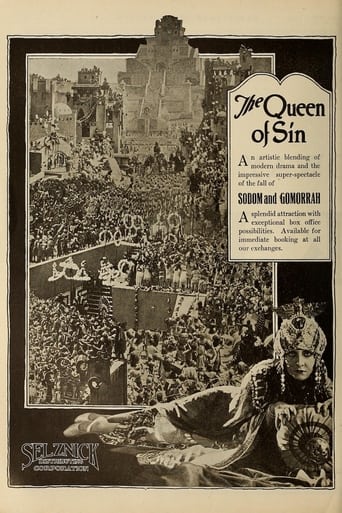
Sodom and Gomorrah (1922)
Sodom und Gomorrha
Exposed to bad influences since childhood, Mary, a young girl is pushed by her mother to approach an elderly banker by the name of Harber. After almost driving her fiancee to suicide and seducing his mentally-ill son, she realizes through a metaphorical dream the scope of her negligence. Sentenced to prison for incitement to murder Harber, she sees herself as a parallel figure to Lea, Lot's wife in Sodom, where the Angel of the Lord warns the sinful citizens of the city of their impending doom. Lea oppresses the angel and eventually turns it over to the pagan priests when her sexual advances to it are rejected. In another dream sequence, Mary becomes the Queen of Syria, whose oppressed people turn against her and who, in turn, condemns a young man who loves her to death. Finally, her dream returns to the present time and when she awakens, she runs back to her former lover.
- Date of release
- 1922-10-13
- TMDB
- 6.1 / 10 (16)
- Runtime
- 1h 38m
- Genres
- Drama
- Director
- Michael Curtiz
Casting
- Georg Reimers — Mr. Jackson Harber
- Victor Varconi — Priester des Lyzeums - Engel des Herrn
- Lucy Doraine — Mary Conway / Das Weib des Lot / Lia, Königin von Syrien
- Erika von Wagner — Mrs. Agathe Conway - Marys Mutter
- Walter Slezak — Eduard Harber - Student am Cambridge-Lyzeum / Ein Goldschmied von Galiläa
- Kurt Ehrle — Harry Lighton - Bildhauer / Lot
- Paul Askonas
- Richard Berczeller — Lot
- Gyula Szöreghy
- Béla Balázs — extra
- Willi Forst — extra
- Leo Slezak
Interesting facts
- Based on: Sodom and Gomorrah
Sodom und Gomorrha: Die Legende von Sünde und Strafe is an Austrian silent epic film from 1922. It was shot on the Laaer Berg, Vienna, as the enormous backdrops specially designed and constructed for the film were too big for the Sievering Studios of the production company, Sascha-Film, in Sievering. The film is distinguished, not so much by the strands of its often opaque plot, as by its status as the largest and most expensive film production in Austrian film history. In the creation of the film between 3,000 and 14,000 performers, extras and crew were employed.
Production
The producer was Sascha Kolowrat-Krakowsky, who according to contemporary film magazines came up with the idea, while on a trip to United States to discover more about the American film industry, of making an epic film with many extras in Austria, as such films - Intolerance seems to have been a particular model - were very popular at that time in the US and Kolowrat-Krakowsky had America in view as an additional potential market.
In the film, produced between 1920 and 1922, Mihaly Kertész (later known in the US as Michael Curtiz) directed, and his Hungarian wife Lucy Doraine played the leading role of Mary Conway. Walter Slezak played Edward, the young son of her fiancé. Among the extras, according to their own accounts, were Willi Forst, Hans Thimig, Paula Wessely and Béla Balázs.
The film is unique in Austrian film history on account of its sheer scale, in which it reputedly surpassed the American epics, the Italian films of classical antiquity and the German historical dramas. Thousands of craftsmen, architects, decorators, sculptors, stuccoists, stage and set builders, pyrotechnicians, cameramen, hairdressers, mask makers and tailors, with assistants, labourers and extras, mostly the unemployed and juveniles, found empl…
The outdoor shoots were made at the Laaerberg near Vienna, in the Lainzer Tiergarten, in Laxenburg, in Schönbrunn and on the Steirischer Erzberg. The Laaerberg was particularly suitable for filming, as at this time it was a waste area, with a few clay pits filled with water. Just for the preliminary construction and erection of the backdrops several thousand workers were required.
At the end of the film the temple was supposed to collapse, for which pyrotechnicians were appointed to blow it up. However, there were accidents, causing injuries and deaths, which were to have legal consequences. The director was acquitted, but the chief pyrotechnician was arrested for 10 days and fined 500,000 Kronen.
Read on Wikipedia · Text from Wikipedia, CC BY-SA 4.0. Data from Wikidata.
Recommended
- Gracie 2007 · ★ 6.2
- The Nest 2020 · ★ 6.1
- Lorelei 2020 · ★ 6.0
- Fast Girls 2012 · ★ 6.0
- Herself 2020 · ★ 6.7
- In the Aisles 2018 · ★ 6.9
- Salomé 2013 · ★ 6.1
- The Young One 1960 · ★ 7.0
- The Girl in the Book 2015 · ★ 5.8
- The Last Bus 2021 · ★ 6.5
- The Effect of Gamma Rays on Man-in-the-Moon Marigolds 1972 · ★ 7.3
- Strange Weather 2016 · ★ 5.9