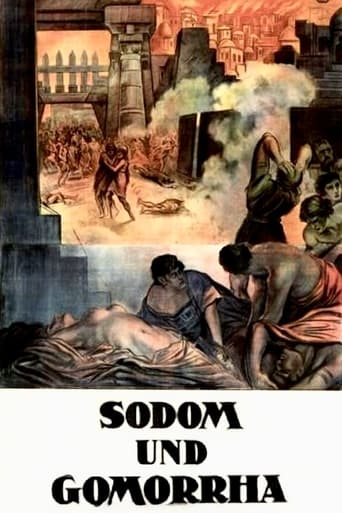
所多玛与蛾摩拉 (1922)
Sodom und Gomorrha
玛丽自幼受不良风气影响,被母亲唆使接近年迈的银行家哈伯。在几乎逼死未婚夫、又引诱其患有精神疾病的儿子后,她通过一场隐喻性的梦境意识到自己的过错何其深重。因教唆谋杀哈伯入狱后,她将自己视作索多玛城中罗得之妻莉亚的镜像——当上帝使者警告这座罪恶之城即将覆灭时,莉亚因求欢被拒而囚禁天使,最终将其交给异教祭司。在另一段梦境中,玛丽化身为叙利亚女王,受压迫的民众群起反抗,她竟将深爱自己的青年判处死刑。最终梦境回归现实,苏醒后的她奔向旧爱身旁。
演员阵容
- Georg Reimers — Mr. Jackson Harber
- Victor Varconi — Priester des Lyzeums - Engel des Herrn
- Lucy Doraine — Mary Conway / Das Weib des Lot / Lia, Königin von Syrien
- Erika von Wagner — Mrs. Agathe Conway - Marys Mutter
- Walter Slezak — Eduard Harber - Student am Cambridge-Lyzeum / Ein Goldschmied von Galiläa
- Kurt Ehrle — Harry Lighton - Bildhauer / Lot
- Paul Askonas
- Richard Berczeller — Lot
- Gyula Szöreghy
- Béla Balázs — extra
- Willi Forst — extra
- Leo Slezak
趣闻
- 改编自:所多瑪與蛾摩拉
Sodom und Gomorrha: Die Legende von Sünde und Strafe is an Austrian silent epic film from 1922. It was shot on the Laaer Berg, Vienna, as the enormous backdrops specially designed and constructed for the film were too big for the Sievering Studios of the production company, Sascha-Film, in Sievering. The film is distinguished, not so much by the strands of its often opaque plot, as by its status as the largest and most expensive film production in Austrian film history. In the creation of the film between 3,000 and 14,000 performers, extras and crew were employed.
Production
The producer was Sascha Kolowrat-Krakowsky, who according to contemporary film magazines came up with the idea, while on a trip to United States to discover more about the American film industry, of making an epic film with many extras in Austria, as such films - Intolerance seems to have been a particular model - were very popular at that time in the US and Kolowrat-Krakowsky had America in view as an additional potential market.
In the film, produced between 1920 and 1922, Mihaly Kertész (later known in the US as Michael Curtiz) directed, and his Hungarian wife Lucy Doraine played the leading role of Mary Conway. Walter Slezak played Edward, the young son of her fiancé. Among the extras, according to their own accounts, were Willi Forst, Hans Thimig, Paula Wessely and Béla Balázs.
The film is unique in Austrian film history on account of its sheer scale, in which it reputedly surpassed the American epics, the Italian films of classical antiquity and the German historical dramas. Thousands of craftsmen, architects, decorators, sculptors, stuccoists, stage and set builders, pyrotechnicians, cameramen, hairdressers, mask makers and tailors, with assistants, labourers and extras, mostly the unemployed and juveniles, found empl…
The outdoor shoots were made at the Laaerberg near Vienna, in the Lainzer Tiergarten, in Laxenburg, in Schönbrunn and on the Steirischer Erzberg. The Laaerberg was particularly suitable for filming, as at this time it was a waste area, with a few clay pits filled with water. Just for the preliminary construction and erection of the backdrops several thousand workers were required.
At the end of the film the temple was supposed to collapse, for which pyrotechnicians were appointed to blow it up. However, there were accidents, causing injuries and deaths, which were to have legal consequences. The director was acquitted, but the chief pyrotechnician was arrested for 10 days and fined 500,000 Kronen.
在维基百科阅读更多 · 文本来自维基百科,CC BY-SA 4.0。数据来自 Wikidata。