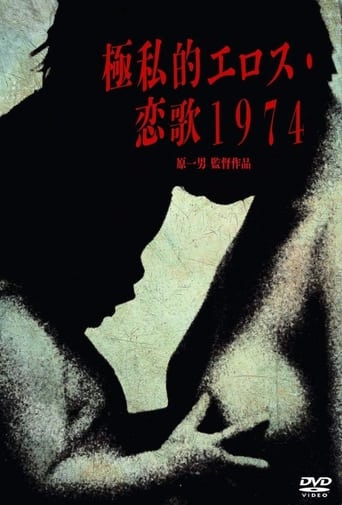
極私的エロス 恋歌1974 (1974)
When his wife, the outspoken feminist Miyuki Takeda, announced that she was leaving him in order to find herself, Kazuo Hara began this raw, intensely personal documentary as a way to both maintain a connection to the woman he still cared for and to make sense of their complex relationship. Granted at times shockingly intimate access to Miyuki’s personal life, Hara follows her wayward journey toward liberation as she explores her sexuality with both men and women, becomes pregnant and raises a family as a single mother, and grows increasingly disenchanted with the constraints of traditional social structures.
- Erscheinungsdatum
- 1974-06-25
- TMDB
- 6.8 / 10 (14)
- Laufzeit
- 1 Std. 38 Min.
- Genres
- Dokumentarfilm
- Regie
- 原一男
Besetzung
- 原一男 — Himself
- 武田美由紀 — Herself / former lover of Hara
- Sachiko Kobayashi — Herself
Wissenswertes
Extreme Private Eros: Love Song 1974 is a 1974 Japanese documentary film by director Kazuo Hara. The documentary centres on Hara's former partner, Miyuki Takeda, and follows her after she moves to Okinawa with their son, where she pursues relationships with a woman and later an American serviceman. The film documents Takeda's life as a single mother and feminist, as well as her pregnancy and eventual unassisted childbirth, while examining Hara's continuing relationship with her and his own position behind the camera.
Production
Extreme Private Eros: Love Song 1974 was Kazuo Hara's second feature-length documentary following Goodbye CP (1972). Produced by Sachiko Kobayashi through Shisso Productions, it was shot by Hara in black-and-white on 16mm, with sound by Yukio Kubota, editing by Jun Nabeshima and music by Tokiko Kato.
Following her separation from Hara, Takeda became involved with the Japanese Women's Liberation movement and moved to Okinawa. Hara later recalled that Takeda proposed that he make a film about her activities there. He expected the project to involve her criticising him and their former relationship from a feminist perspective, and saw this confrontation as the basis for a new kind of documentary.
Kobayashi was instrumental in organising and financing the production. Following screenings of Goodbye CP, she sought to use its independent exhibition network to raise money for a new film concerned with women's liberation. She also became a participant in the documentary when Hara brought her to meet Takeda in Okinawa.
Hara's personal involvement became increasingly visible during filming. He later described the camera as an extension of his body, connecting his practice to contemporary Japanese discussions of the “camera as violence”. At one point, while filming Takeda with another man, Hara became overwhelmed by jealousy and handed the camera to a friend, resulting in footage of Hara himself crying.
Takeda also influenced what Hara filmed. Most notably, after deciding to give birth without medical assistance, she asked him to record the delivery. Hara later said that he understood her request as a desire to see herself undergoing an experience that she could not observe directly.
Auf Wikipedia weiterlesen · Text aus Wikipedia, CC BY-SA 4.0. Daten aus Wikidata.
Empfohlen
- Meine Mutter Jayne Mansfield 2025 · ★ 8.0
- Hayao Miyazaki und der Reiher 2024 · ★ 7.8
- Alexander McQueen – Der Film 2018 · ★ 7.4
- Come See Me in the Good Light 2025 · ★ 7.1
- Avatar: The Deep Dive - A Special Edition of 20/20 2022 · ★ 7.2
- A Toxic Love Story 2026 · ★ 6.4
- You Can See Everything 2026 · ★ 9.1
- 28 Up 1985 · ★ 7.5
- We Live in Public 2009 · ★ 6.8
- 180° South 2010 · ★ 7.2
- S4: The Bob Lazar Story 2026 · ★ 8.4
- I Am Ali 2014 · ★ 6.7