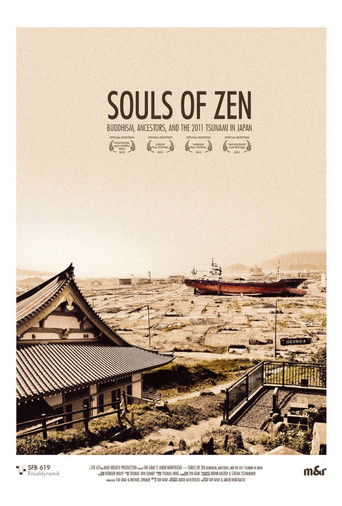
Souls of Zen: Ancestors and Agency in Contemporary Japanese Temple Buddhism (2012)
The Japanese population’s reaction to the catastrophe of March 2011 has been described as “stoic” by the Western media. The Japanese code of conduct is indeed deeply rooted in their Buddhist traditions, and young filmmakers Tim Graf and Jakob Montrasio observe in detail what this means for the people and their religion. At graveyards, in temples, at monasteries and with families, they question the impact this triple affliction has had on the lives and beliefs of the inhabitants. How deeply do their beliefs affect their grieving? What role do the monks play in assisting people with their grief? And, what effects has this enormous catastrophe had on their religious rituals? SOULS OF ZEN inserts the events of March 2011 into the context of traditional Zen Buddhism, examining Japan’s religiousness and the beliefs of those practising it at a crucial turning point.
- Fecha de estreno
- 2012-06-01
- TMDB
- 8.0 / 10 (2)
- Duración
- 1 h 29 min
- Géneros
- Documental
- Director
- Tim Graf, Jakob Montrasio
Reparto
- Tenzin Gyatso — Self
- Tomonori Abe — Self
Curiosidades
Souls of Zen is a 2012 German documentary film directed by Tim Graf and Jakob Montrasio. It follows Zen Buddhist priests, temple communities and bereaved families in north-eastern Japan in the months after the 2011 Tōhoku earthquake and tsunami, and looks at the role Buddhist funeral and ancestor rites played in coping with the disaster. The film premiered in competition at the 2012 Zurich Film Festival.
Production
In early 2011, Tim Graf, a doctoral researcher in religious studies from Heidelberg, began fieldwork in Japan on the visual culture of Zen Buddhism, and Montrasio was to film everyday life in Zen temples for the project. The two had originally planned a half-hour film. After the earthquake and tsunami of 11 March 2011, the two abandoned their original plan and instead accompanied Zen priests during relief work in the affected regions.
Among those interviewed are temple priests in Sendai and the religious studies scholar Kimura Toshiaki of Tohoku University; the filmmakers otherwise gave most of the screen time to people affected by the disaster and to Buddhist clergy. One priest describes how, with no coffins available, his temple built its own wooden boxes for the dead.
Leer en Wikipedia · Texto de Wikipedia, CC BY-SA 4.0. Datos de Wikidata.
Recomendadas
- Camina conmigo 2017 · ★ 5.9
- Powaqqatsi 1988 · ★ 7.2
- Voyage of Time: The IMAX Experience 2016 · ★ 6.9
- Jonestown: The Life and Death of Peoples Temple 2006 · ★ 7.1
- El secreto 2006 · ★ 6.6
- Corazon de Perro 2015 · ★ 6.5
- My Life Directed by Nicolas Winding Refn 2015 · ★ 6.4
- Birmania VJ: Informando desde un país cerrado 2008 · ★ 7.3
- Downloaded 2013 · ★ 6.5
- Naqoyqatsi 2002 · ★ 6.2
- Líbranos del mal 2006 · ★ 7.2
- Por el amor de Spock 2016 · ★ 7.4