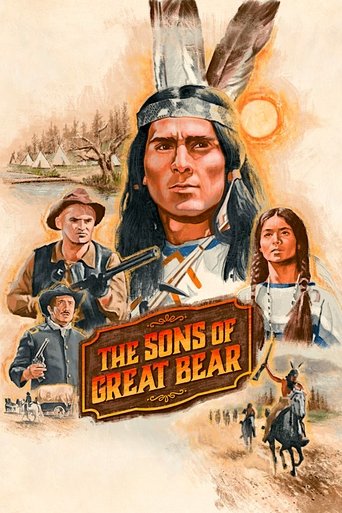
The Sons of Great Bear (1966)
Die Söhne der großen Bärin
As American settlers encroach on the lands of the Lakota people, Tokei-ihto witnesses the murder of his father at the hands of Red Fox, who wanted information on where the tribe finds its gold. Two years later, at the height of the Great Sioux War, Tokei-ihto and Red Fox meet again.
- Date of release
- 1966-02-18
- TMDB
- 5.1 / 10 (16)
- Runtime
- 1h 38m
- Genres
- Drama, Western, Adventure
- Director
- Josef Mach
Casting
- Gojko Mitić — Tokei-Ihto
- Jiří Vršťala — Red Fox
- Rolf Römer — Tobias
- Hans Hardt-Hardtloff — Major Smith
- Gerhard Rachold — Lieutenant Roach
- Horst Jonischkan — Adams
- Jozef Majerčík — Tschetansapa
- Milan Jablonský — Donner vom Berge
- Jozef Adamovič — Tschapa
- Hannjo Hasse — Pitt
- Helmut Schreiber — Ben
- Rolf Ripperger — Joe
Interesting facts
- Based on: The Sons of the Great Bear
The Sons of Great Bear is a 1966 East German Western film, directed by the Czechoslovak filmmaker Josef Mach and starring the Yugoslav actor Gojko Mitić in the leading role of Tokei-ihto. The script was adapted from the eponymous series of novels by author Liselotte Welskopf-Henrich, and the music composed by Wilhelm Neef. The picture is a revisionist Western, pioneering the genre of the Ostern, and emphasises the positive portrayal of Native Americans, while presenting the Whites as antagonists. It is one of the most successful pictures produced by the DEFA film studio, known for its series of "Indian films".
Production
The Western genre had never enjoyed the approval of the political establishment in the German Democratic Republic: the novels of Karl May, the most prominent German-language author associated with the topic, were not allowed to be re-published in the country until 1982.
East Germany had its own writers who dealt with the subject, though. The Munich-born Liselotte Welskopf-Henrich composed a first draft of a novel set in the land of the Sioux in 1918, when she was 17 years old. After the end of the Second World War, Henrich joined the Communist Party of Germany and settled in East Berlin, where she held a tenure as a Classics professor at the Humboldt University of Berlin. She finished her book in 1951.
The attitude of the DEFA studio – the country's state-owned cinema monopoly – to Westerns changed in the early 1960s, with the release of a wave of Karl May films produced in West Germany, especially the series directed by Harald Reinl which began with Apache Gold in 1963. While not distributed in the GDR, East German tourists could view them when vacationing in neighboring Czechoslovakia.
While the studio accepted the idea of making a Western, most of its filmmakers regarded it with skepticism, and did not believe it would garner success. When Mahlich sought a director for his upcoming production, no East German agreed to participate, as none was ready to risk his reputation. He had to enlist the Czechoslovak director Josef Mach, and his fellow countryman Jaroslav Tuzar as cinematographer.
A central feature of the production was the striving for authenticity and the resolve to reverse the genre conventions by stressing the Native American perspective: The film "shifted the focus to natives solely as victims and Americans as perpetrators". Theodore C. Van Alst, who studied the depiction of Native Americans in European film, noted that as it was made "many miles from the Great Plains...
Read on Wikipedia · Text from Wikipedia, CC BY-SA 4.0. Data from Wikidata.
Recommended
- Winnetou - A New World 2016 · ★ 6.3
- The Way West 1967 · ★ 6.1
- The Desperado Trail 1965 · ★ 6.8
- The Call of the Wild 1972 · ★ 6.1
- Tall Tale: The Unbelievable Adventure 1995 · ★ 6.2
- Dances with Wolves 1990 · ★ 7.8
- True Grit 1969 · ★ 7.3
- Davy Crockett, King of the Wild Frontier 1955 · ★ 6.4
- Man in the Shadow 1957 · ★ 6.7
- Last of the Dogmen 1995 · ★ 6.8
- Winnetou and the Crossbreed 1966 · ★ 6.2
- Treasure of Silver Lake 1962 · ★ 7.1