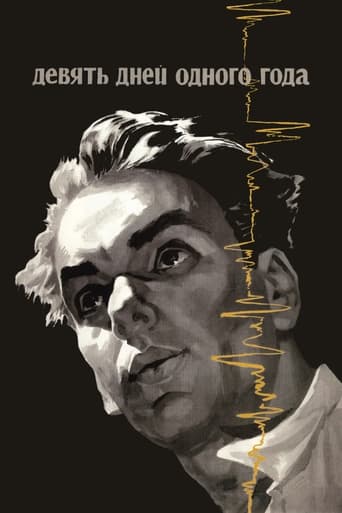
Девять дней одного года (1962)
Set in the Soviet scientific community, the story follows two dedicated physicists whose close friendship unfolds amid dangerous nuclear research, shaped by their shared affection for a strong-willed woman. Radiation exposure, scientific ambition, and romantic rivalries intersect as the characters confront the physical risks of their work and the personal consequences of their choices.
- Data de estreia
- 1962-03-05
- TMDB
- 6.8 / 10 (34)
- Duração
- 1 h 49 min
- Géneros
- Drama
- Realizador
- Михаил Ромм
Elenco
- Алексей Баталов — Dmitri Gusev
- Иннокентий Смоктуновский — Ilya Kulikov
- Татьяна Лаврова — Lyolya
- Михаил Козаков — Valery Ivanovich
- Николай Плотников — Professor Sintsov
- Сергей Блинников — Butov
- Евгений Евстигнеев — Nikolai Ivanovich
- Валентин Никулин — young physicist
- Павел Шпрингфельд — physicist
- Люсьена Овчинникова — Nura, Gusev's younger sister
- Андрей Смирнов — tall bearded physicist
- Евгений Тетерин — Surgeon
Curiosidades
- Prémios: 1 · Nomeações: 0. Incluindo: Best Film of the Year (Soviet Screen)
Nine Days in One Year is a 1962 Soviet black-and-white drama film directed by Mikhail Romm about nuclear particle physics, physicists and their relationships. The film is based on true events. It won the Crystal Globe Award in 1962.
Production
The film's working title was 365 Days. Mikhail Romm assembled a team of people with whom he had never previously worked before.
Popular actors Yury Yakovlev and Alexey Batalov were hired for the main roles. Before the filming started, Yakovlev was hospitalized and had to be replaced with Innokenty Smoktunovsky. For the main female part a young and little-known actress Tatyana Lavrova of the Sovremennik Theatre was invited. The role of Lyolya was Tatiana’s best known role in her film career, later she mainly devoted herself to the theater.
I had great interest in working on my portrayal of Dmitry Gusev. The life of this atomic scientist is filled with a persistent, meaningful and moreover with quite an inconspicuous feat. The role of Gusev especially appeals to me the fact that he is a modern man, deeply intelligent, we can say – a man of the new Soviet formation.
The screenplay was written by Romm jointly with Khrabrovitsky. The cinematographer of the film was a newcomer German Lavrov. In many respects, the picture became a new word in the Soviet cinema. Experts have noted an unusual interpretation of the theme song and sound engineering - in fact there is almost no music, there is only a certain sound accompaniment of the technological sense. The sets of the film were also innovative.
The filming took 6 months. The premiere was on 5 March 1962 at the Rossiya Theatre in Moscow.
Ler na Wikipédia · Texto da Wikipédia, CC BY-SA 4.0. Dados do Wikidata.
Recomendados
- Grau de Destruição 1966 · ★ 7.1
- Testament 1983 · ★ 6.4
- Panic in Year Zero! 1962 · ★ 6.3
- Quando o Vento Sopra 1986 · ★ 7.5
- Um Novo Fôlego 2013 · ★ 5.9
- Quem Tem Medo de Virginia Woolf? 1966 · ★ 7.7
- Autópsia de Um Crime 2007 · ★ 6.3
- Um Presente do Passado 2015 · ★ 6.7
- A Balada de Adam Henry 2018 · ★ 6.6
- The Unlikely Pilgrimage of Harold Fry 2023 · ★ 6.6
- O Buraco da Agulha 1981 · ★ 6.7
- Sonhos e Comboios 2025 · ★ 7.3