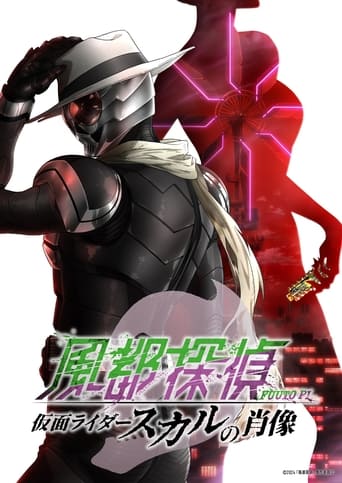
Fuuto PI: The Portrait of Kamen Rider Skull (2024)
風都探偵 仮面ライダースカルの肖像
Shōtarō erzählt Tokime von seiner Vergangenheit. Wie hat er damals als Detektiv angefangen?
- Erscheinungsdatum
- 2024-11-08
- TMDB
- 8.0 / 10 (11)
- Laufzeit
- 1 Std. 22 Min.
- Genres
- Animation, Action, Abenteuer, Komödie
- Regie
- 椛島洋介
Besetzung
- Kenjiro Tsuda — Sokichi Narumi / Kamen Rider Skull (voice)
- Yoshimasa Hosoya — Shotaro Hidari / Kamen Rider W (voice)
- Koki Uchiyama — Philip / Kamen Rider W (voice)
- Akira Sekine — Tokime (voice)
- Mikako Komatsu — Akiko Narumi (voice)
- Makoto Furukawa — Ryu Terui (voice)
- Daisuke Ono — Yukiji Bando (voice)
- Ayumu Murase — Young Shotaro Hidari (voice)
- Satomi Sato — Saeko Sonozaki / Taboo Dopant (voice)
- Jun Fukuyama — Nagi Ooshima / Ocean Dopant (voice)
- 幸田直子 — Fumine Sonozaki (voice)
- 宝亀克寿 — Ryubei Sonozaki (voice)
Wissenswertes
- Basiert auf: Fūto Tantei
Fuuto PI: The Portrait of Kamen Rider Skull is a 2024 Japanese anime film directed by Yōsuke Kabashima, written by Tatsuto Higuchi and animated by Studio Kai. The film stars Yoshimasa Hosoya, Ayumu Murase, Kōki Uchiyama, and Kenjirō Tsuda, among others. Based on the manga series Fuuto PI by Riku Sanjo, the film serves as the origin story of detective Shotaro Hidari. Shotaro becomes the protector of the city of Fuuto under his Kamen Rider W persona while working with Sokichi Narumi to rescue a young Philip, who is being used by his family to create monsters known as Dopants.
Production
Toei announced the film in June 2024, with the voice cast from Fuuto PI's anime adaptation reprising their roles. Due to the popularity of the anime adaptation, initial plans for the theatrical version involved continuing its story, but scheduling constraints at Studio Kai prevented an immediate continuation.
Kabashima studied Kamen Rider W: Begins Night to prepare for the production. However, he cut certain aspects he disliked of Kamen Rider W's treatment of Skull's story. Nagi Ōshima was created as an original character for the movie. The director tried to avoid portraying Ōshima as a pitiful character, and instead tell an interesting story about him and Saeko.
Kabashima praised the performance of the two main actors, stating that they needed minimal guidance. He commended Tsuda's performance as Narumi for his easy-going portrayal and faithfulness to the original live-action television series. Kabashima intended to depict Narumi as a role model for Shotaro and others to look up to.
Shotaro cries in three scenes, which Kabashima felt were crucial to put effort into animating for the sake of appealing emotionally to the audience. In particular, the final scene where Shotaro falls asleep next to Tokime was intended to be deeply moving. He spoke to the animator, Ebinama, and asked him to create a unique visual effect of a film of tears for these scenes.
Kabashima named Masami Obari as a major directorial influence for his animation choices. He combined 3D animation with 2D animation in several scenes, such as the first time Shotaro enters Narumi's office. While he was pleased with the final result, he felt there was room for improvement in animation quality and direction; in particular, he wanted the animation team to be able to improve and rework scenes on their own.
Auf Wikipedia weiterlesen · Text aus Wikipedia, CC BY-SA 4.0. Daten aus Wikidata.
Empfohlen
- Accident Man: Hitman's Holiday 2022 · ★ 6.8
- Batman: The Long Halloween - Teil 2 2021 · ★ 7.4
- One Piece: Episode of East Blue - Die großen Abenteuer von Ruffy und seinen vier Freunden! 2017 · ★ 7.7
- Batman: The Long Halloween Deluxe Edition 2022 · ★ 7.2
- Batman: Soul of the Dragon 2021 · ★ 6.7
- The Fable: The Killer Who Doesn't Kill 2021 · ★ 7.0
- The Fable 2019 · ★ 6.7
- Hentai Kamen 2 - The Abnormal Crisis 2016 · ★ 6.3
- Sheroes 2023 · ★ 5.8
- Rurouni Kenshin 2012 · ★ 7.5
- InuYasha - Der Film 2: Das Traumschloss im Inneren der Spiegel 2002 · ★ 7.7
- Demon Slayer: Kimetsu no Yaiba Infinity Castle 2025 · ★ 8.8