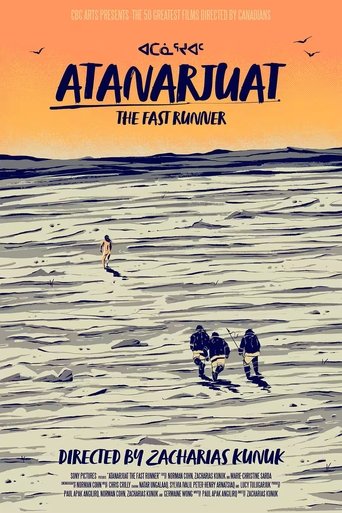
Atanarjuat, la leyenda del hombre veloz (2002)
ᐊᑕᓈᕐᔪᐊᑦ
Basada en una leyenda milenaria de un pueblo indígena canadiense, narra la historia de una maldición provocada por un diabólico chamán. Los malos espíritus provocaron un conflicto entre dos familias que saltó generación tras generación. Hablada en lenguaje Inuktitut, lengua indígena de algunas tribus indias del norte de Canadá, obtuvo excelentes críticas por parte de todos los medios norteamericanos, sin excepción.
- Fecha de estreno
- 2002-02-01
- TMDB
- 6.8 / 10 (84)
- Duración
- 2 h 52 min
- Géneros
- Fantasía, Drama
- Director
- Zacharias Kunuk
Reparto
- Natar Ungalaaq — Atanarjuat
- Sylvia Ivalu — Atuat
- Peter-Henry Arnatsiaq — Oki
- Lucy Tulugarjuk — Puja
- Pakak Innuksuk — Amaqjuaq (as Pakkak Innushuk)
- Madeline Ivalu — Panikpak
- Pauloosie Qulitalik — Qulitalik / A shaman (as Paul Qulitalik)
- Eugene Ipkarnak — Sauri, the chief
- Neeve Irngaut — Uluriaq
- Abraham Ulayuruluk — Tungajuaq
- Apayata Kotierk — Kumaglak
- Mary Qulitalik — Niriuniq
Curiosidades
- Recaudación: 5,2 M US$
- Presupuesto: 2 M CAD
- Premios: 2 · Nominaciones: 1. Incluyendo: Premio Genie a la mejor película; Toronto International Film Festival Award for Best Canadian Film
Atanarjuat: The Fast Runner is a 2001 Canadian epic film directed by Inuk filmmaker Zacharias Kunuk and produced by his company Isuma Igloolik Productions. It was the first feature film ever to be written, directed and acted entirely in the Inuktitut language.
Production
The film is set in Igloolik ("place of houses") in the Eastern Arctic wilderness at the dawn of the first millennium. The names of Atanarjuat and his brother first appeared in writing in the journals of the explorer Captain George Lyon, who took part in a British expedition to search for the Northwest Passage in 1821–23. The Inuit believe the story of Atanarjuat to be more than five centuries old.
Writer Paul Apak Angilirq, director Zacharias Kunuk, and many others on the production team had heard the Atanarjuat legend when they were young. Over the course of five years, Angilirq interviewed seven elders for their versions of the story and combined them into one treatment. The final script was developed by the team of Angilirq, Norman Cohn (producer and cinematographer), Kunuk, Herve Paniaq (tribal elder), and Pauloosie Qulitalik.
Despite the emphasis on accuracy, the film takes liberties with the original Inuit myth: "At the film's core is a crucial lie", wrote Justin Shubow in The American Prospect, which is that the original legend ended in a revenge killing, whereas in the film Atanarjuat stops short of shedding blood.
After Isuma applied to Telefilm Canada in spring 1998 for financial support, plans were made to begin filming in Igloolik, Nunavut in April. The month was important because April is typically the only time of year in Northern Canada when camera equipment could film winter scenes without malfunctioning due to cold.
Due to difficulty with funding, Isuma instead successfully appealed for support of the National Film Board of Canada. Although the NFB had abandoned fiction, Isuma argued that in documenting Inuit mythology, Atanarjuat was similar to a documentary film. The budget was approved at $1.96 million.
Leer en Wikipedia · Texto de Wikipedia, CC BY-SA 4.0. Datos de Wikidata.
Recomendadas
- Valhalla Rising 2010 · ★ 6.1
- El hombre del norte 2022 · ★ 7.0
- Mortal 2020 · ★ 6.5
- En el bosque 2016 · ★ 5.8
- Martha Marcy May Marlene 2011 · ★ 6.6
- La boda de Rachel 2008 · ★ 6.3
- Tuesday 2024 · ★ 6.8
- Melancolía 2011 · ★ 7.1
- El último mohicano 1992 · ★ 7.4
- Estocolmo 1520. El rey Tirano 2024 · ★ 6.3
- El poder del perro 2021 · ★ 6.7
- Beast (La bestia) 2026 · ★ 7.5