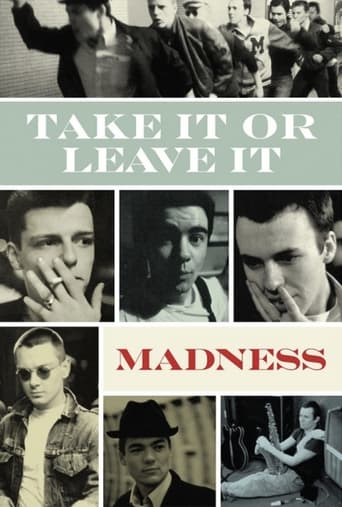
Take It or Leave It (1981)
Madness, Madness, they call it Madness.
Take It or Leave It is an autobiographical account of the cult '80s British pop group Madness, with members of the group playing themselves, charting their rise from humble beginnings as pub band The Invaders to chart success and their first overseas tour. The film follows the ups and downs of individual members of the group, and features all of their early hits including The Prince, One Step Beyond, Baggy Trousers, and Night Boat to Cairo.
- Date of release
- 1981-10-08
- TMDB
- 6.8 / 10 (9)
- Runtime
- 1h 23m
- Genres
- Documentary, Music
- Director
- Dave Robinson
Casting
- Suggs — Suggs
- Mark Bedford — Bedders
- Lee Thompson — Lee Thompson
- Chas Smash — Carl
- Dan Woodgate — Woody
- Chris Foreman — Chris
- Mike Barson — Barso
- John Hasler — Hasler
- Simon Birdsall — Simon
- Andrew Chalk — Chalky
- Ian Tokins — Toks
- Gerard Kelly — Dick the Ted
Interesting facts
Take It or Leave It is a 1981 British documentary/drama/comedy film directed by Dave Robinson, about the formation of the British ska/pop band Madness. It stars the members of the band and was financed by themselves.
Production
Madness had its origins in a group formed in 1976, being renamed Madness in 1979, the year of the release of the band's first album, One Step Beyond.... The album was very successful as was its follow up Absolutely, and the band had nine hit singles in a row. According to Daniel Woodgate, "We thought, ‘Well, we’ve done it all now, let’s make a film of our story'."
Suggs said "We just thought a film was a natural step as our early years were so dependent on our visual stuff, which is almost as important as the music. "
The film's budget of £400,000 was paid with £250,000 from Stiff Records with the rest paid for by the band and their manager. According to Suggs, "The money came from the first big royalty cheque we ever received, so we thought that the best thing would be to invest it in something like a film, rather than just blow it all. It was a great opportunity to show the way we were in the early days and how we’d changed."
The film was directed by the owner of Madness label Stiff Records, Dave Robinson, who had never made a feature before but had directed some of the band's music videos, notably "Baggy Trousers" and "One Step Beyond". "The band’s videos were getting a lot of attention and they’d already proved how good they were in front of the camera," said Robinson.
"It was meant to be about a bunch of ordinary people who form a band and eventually make a record and shows that anyone can do it," said Suggs. "It was about us as people more than us as part of the music industry."
Read on Wikipedia · Text from Wikipedia, CC BY-SA 4.0. Data from Wikidata.
Recommended
- Selena Gomez: My Mind & Me 2022 · ★ 8.4
- The Sparks Brothers 2021 · ★ 7.4
- The Beach Boys 2024 · ★ 6.7
- Supersonic 2016 · ★ 7.4
- Anvil! The Story of Anvil 2008 · ★ 7.6
- Biggie & Tupac 2002 · ★ 6.4
- Rolling Thunder Revue: A Bob Dylan Story by Martin Scorsese 2019 · ★ 7.0
- Biggie: I Got a Story to Tell 2021 · ★ 7.1
- Milli Vanilli 2023 · ★ 7.0
- Beastie Boys Story 2020 · ★ 7.5
- The Rise of the Red Hot Chili Peppers: Our Brother, Hillel 2026 · ★ 7.3
- Halftime 2022 · ★ 6.8