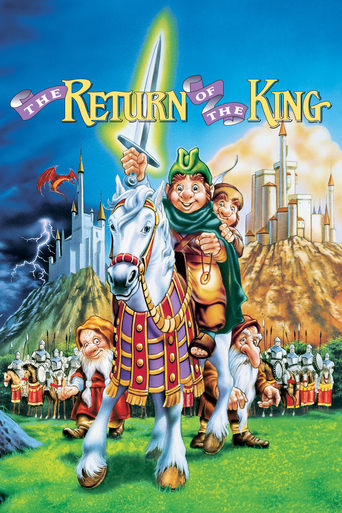
The Return of the King (1980)
Two Hobbits struggle to destroy the Ring in Mount Doom while their friends desperately fight evil Lord Sauron's forces in a final battle.
- Date of release
- 1980-05-11
- TMDB
- 6.4 / 10 (229)
- Runtime
- 1h 38m
- Genres
- Animation, Fantasy, Adventure
- Director
- Arthur Rankin Jr., Jules Bass
- Collection
- The Lord of the Rings (Animated) Collection
Casting
- Orson Bean — Frodo Baggins / Bilbo Baggins (voice)
- Roddy McDowall — Samwise Gamgee (voice)
- John Huston — Gandalf (voice)
- Theodore Gottlieb — Gollum (voice)
- Casey Kasem — Meriadoc 'Merry' Brandybuck (voice)
- Sonny Melendrez — Peregrin 'Pippin' Took (voice)
- Theodore Bikel — Aragorn (voice)
- William Conrad — Lord Denethor (voice)
- Don Messick — King Theoden / Easterling / The Mouth of Sauron (voice)
- Paul Frees — Orc / Uruk-Hai / Capt. Shagrat / Lt. Snaga / Lord Elrond (voice)
- John Stephenson — Gondorian Guard / Dwimmerlaik - The Witch-King of Angmar (voice)
- Nellie Bellflower — Eowyn / Dernhelm (voice)
Interesting facts
- Budget: $3M
- Based on: The Return of the King
The Return of the King is a 1980 animated musical fantasy television film. It is a sequel to The Hobbit (1977). The film is an adaptation of The Return of the King, the third and final volume of the 1955 novel The Lord of the Rings by J. R. R. Tolkien. The first two parts of Tolkien's story, The Fellowship of the Ring and The Two Towers, are not covered in this release and are only briefly summarized at the beginning of the movie.
Production
After the 1977 broadcast of The Hobbit on NBC, development and production began on The Return of the King at Rankin/Bass Productions in New York City under supervision of Arthur Rankin Jr. and Jules Bass. The film's original working title was Frodo, The Hobbit II. It was written by Romeo Muller with Rankin doing the script, designs for the characters and storyboards.
Orson Bean returned as the voice of the older Bilbo Baggins, as well as that of the story's hero, Frodo Baggins. John Huston also came back, as the wizard Gandalf, and co-starring with them were: William Conrad as Denethor, Roddy McDowall as Samwise Gamgee, Theodore Bikel as Aragorn, and reprising his role of Gollum, Brother Theodore.
The release was threatened by a lawsuit filed by the Tolkien Estate and Fantasy Films on the basis that Rankin/Bass had not secured the U.S. and Canadian television rights to J. R. R. Tolkien's book. The lawsuit was settled "amicably", allowing it to proceed with a May 1980 release.
The film is often mistaken for a sequel to Ralph Bakshi's 1978 animated film The Lord of the Rings. After Rankin/Bass became defunct in 1987, Warner Bros. acquired the rights to the special for home video distribution and chose to market the film, in addition with The Hobbit, as installments of an animated Tolkien trilogy, with Bakshi's The Lord of the Rings (by then also owned by Warner Bros., from United Artists) acting as the middle chapter.
Read on Wikipedia · Text from Wikipedia, CC BY-SA 4.0. Data from Wikidata.
Recommended
- The Lord of the Rings 1978 · ★ 6.6
- Legends of Oz: Dorothy's Return 2014 · ★ 6.2
- The Lord of the Rings: The Rings of Power Global Fan Screening 2022 · ★ 7.5
- The Flight of Dragons 1982 · ★ 6.8
- Strange Magic 2015 · ★ 7.3
- Happily Ever After 1989 · ★ 5.8
- The Hobbit 1977 · ★ 6.6
- Pinocchio 2022 · ★ 6.2
- Rudolph and Frosty's Christmas in July 1979 · ★ 6.4
- Gulliver's Travels 1939 · ★ 6.2
- Descendants 2 2017 · ★ 7.4
- A Tooth Fairy Tale 2025 · ★ 8.5