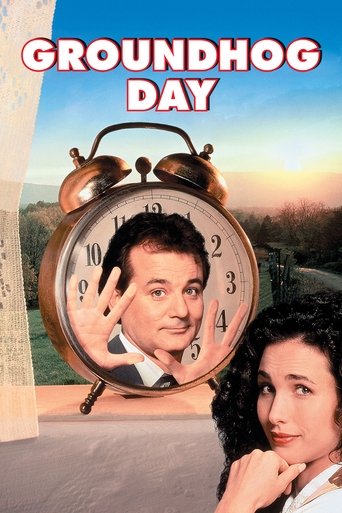
Groundhog Day (1993)
He’s having the worst day of his life… Over and over again.
A cynical TV weatherman, along with his idealistic producer and his sardonic cameraman, is sent to report on Groundhog Day in the small town of Punxsutawney, where he finds himself repeating the same day over and over.
- Date of release
- 1993-02-11
- TMDB
- 7.6 / 10 (9397)
- Runtime
- 1h 41m
- Genres
- Romance, Fantasy, Comedy
- Director
- Harold Ramis
Casting
- Bill Murray — Phil
- Andie MacDowell — Rita
- Chris Elliott — Larry
- Stephen Tobolowsky — Ned
- Brian Doyle-Murray — Buster
- Marita Geraghty — Nancy
- Angela Paton — Mrs. Lancaster
- Rick Ducommun — Gus
- Rick Overton — Ralph
- Robin Duke — Doris the Waitress
- Carol Bivins — Anchorwoman
- Willie Garson — Phil's Assistant Kenny
Interesting facts
- Box office: $105M
- Budget: $14.6M
- Earned 7.2× its budget
- Filmed in: Woodstock
- Awards: 6 · Nominations: 4. Including: British Comedy Awards; MTV Movie & TV Awards; Saturn Award for Best Actress; BAFTA Award for Best Original Screenplay
Groundhog Day is a 1993 American fantasy romantic comedy film directed by Harold Ramis, who co-wrote the screenplay with Danny Rubin. Starring Bill Murray, Andie MacDowell, and Chris Elliott, it tells the story of a cynical television weatherman covering the annual Groundhog Day event in Punxsutawney, Pennsylvania, who becomes trapped in a time loop, forcing him to relive February 2 repeatedly. The film also features Stephen Tobolowsky, Brian Doyle-Murray, Marita Geraghty, Angela Paton, Rick Ducommun, Rick Overton, and Robin Duke in supporting roles.
Production
The original idea for Groundhog Day came to writer Danny Rubin in 1990. He had moved to Los Angeles to work as a screenwriter. While waiting in a theater for a film to start, he was reading Anne Rice's book The Vampire Lestat (1985). Rubin began musing about vampiric immortality and what one would do with their time if it was limitless.
Having recently sold his first script for what would become the thriller film Hear No Evil (1993), his agent prompted him to develop a "calling-card" script that he could use to gain meetings with producers. Rubin began work on his idea of a man changing over eternal life, but quickly realized that the idea was impractical because of the expense of depicting historical and future events.
Rubin opened a calendar and picked the next nearest holiday, February 2, Groundhog Day. He saw it as a date with story potential because it was a recognized holiday without much widespread attention. Rubin believed that people were vaguely aware of the holiday, on which a groundhog predicts the coming of spring.
Rubin spent eight weeks working on the story: seven making notes to define the rules and characters, and one writing the script. He struggled to establish a cause for the time loop, considering technological, magical, and celestial origins. He considered these methods interchangeable and felt the cause was unimportant and could detract from the story elements he wanted to focus on.
Rubin did not initially write the film as a broad comedy, considering it more whimsical. He found that the funnier elements were the easiest to think of; one of the earliest scenes he wrote was about Phil using his ever-increasing knowledge to seduce women. Loops were also dedicated to Phil seeing how far he could get outside of Punxsutawney; inevitably, he was always returned to the town.
Read on Wikipedia · Text from Wikipedia, CC BY-SA 4.0. Data from Wikidata.
Recommended
- It Happened Tomorrow 1944 · ★ 6.8
- The 12 Days of Christmas Eve 2022 · ★ 6.1
- 12 Dates of Christmas 2011 · ★ 6.1
- When We First Met 2018 · ★ 6.6
- Midnight at the Magnolia 2020 · ★ 6.3
- The Good Witch's Garden 2009 · ★ 7.5
- New Year's Eve 2011 · ★ 5.9
- Winter Castle 2019 · ★ 6.8
- Z-O-M-B-I-E-S 4: Dawn of the Vampires 2025 · ★ 7.1
- Memoirs of an Invisible Man 1992 · ★ 5.9
- Shrek Forever After 2010 · ★ 6.4
- EXmas 2023 · ★ 6.4