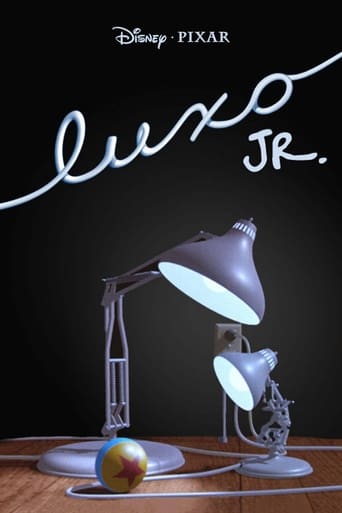
Luxo Jr. (1986)
A baby lamp finds a ball to play with and it's all fun and games until the ball bursts. Just when the elder Luxo thinks his kid will settle down for a bit, Luxo Jr. finds a ball ten times bigger.
- Date of release
- 1986-08-17
- TMDB
- 7.0 / 10 (694)
- Runtime
- 2m
- Genres
- Animation, Comedy
- Director
- John Lasseter
Interesting facts
- Awards: 0 · Nominations: 1
Luxo Jr. is a 1986 American animated short film produced and released by Pixar. Written and directed by John Lasseter, the two-minute short film revolves around one larger and one smaller desk lamp. The larger lamp, named Luxo Sr., looks on while the smaller, "younger" Luxo Jr. plays exuberantly with a ball to the extent that it accidentally deflates. Luxo Jr. was Pixar's first animation after Ed Catmull and John Lasseter left the Lucasfilm Computer Division. The film is the source of Luxo Jr., the mascot of Pixar.
Production
Lasseter's student film at CalArts, The Lady and the Lamp, applied Walt Disney's observation that giving lifelike qualities to inanimate objects held comic potential. Luxo Jr. displayed a further insight, however: that inanimate objects as characters held the potential for dramatic value as well. The film would come from Lasseter's experiments with modeling his Luxo lamp.
Lasseter initially intended Luxo Jr. as a plotless character study. When he showed some early tests at an animation festival in Brussels, Belgium, respected Belgian animator Raoul Servais exhorted him, "No matter how short it is, it should have a beginning, a middle, and an end. Don't forget the story." Lasseter protested that the film would be too short for a story. "You can tell a story in ten seconds", Servais responded.
Apart from the film's hoped-for promotional value, Catmull and Smith rationalized the project as a test of "self-shadowing" in the rendering software- that is, the ability of objects to shed light and shadows on themselves. Before self-shadowing, CGI shadows were made by adding a flattened and darkened version of the shadowed object.
On the technical level, the film demonstrates the use of shadow maps to simulate the shifting light and shadow given by the animated lamps. The lights and the color surfaces of all the objects are calculated, each using a RenderMan surface shader, not surface textures. The articulation of "limbs" is carefully coordinated, and power cords trail believably behind the moving lamps.
Because time and money were tight, Lasseter reduced the setting to its simplest elements. The background would be plain black and there would be no camera movement. His energies would rather be focused instead on working out techniques based on classic animation principles to convey emotion.
Read on Wikipedia · Text from Wikipedia, CC BY-SA 4.0. Data from Wikidata.
Recommended
- Sanjay's Super Team 2015 · ★ 6.4
- Extreme Makeover: Homer Edition 2026 · ★ 7.4
- Home Makeover 2010 · ★ 6.8
- Panic in the Mailroom 2013 · ★ 6.8
- Kung Fu Panda: Secrets of the Scroll 2016 · ★ 6.9
- Tin Toy 1988 · ★ 6.1
- Out on a Limb 1950 · ★ 6.9
- Riley's First Date? 2015 · ★ 7.2
- Banana 2010 · ★ 7.1
- The Ugly Duckling 1939 · ★ 7.0
- Welcome to the Club 2022 · ★ 6.2
- The Big Bad Wolf 1934 · ★ 6.5