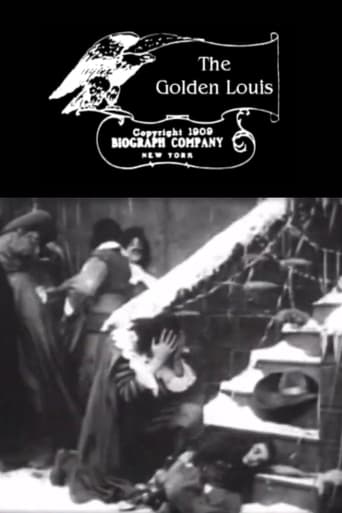
The Golden Louis (1909)
An anonymous donor drops a gold coin in the shoe of a homeless girl as she sleeps. A gambler with a 'sure thing' borrows the coin and wins a fortune, but he can't find her again to repay her.
- Date of release
- 1909-02-22
- TMDB
- 4.6 / 10 (9)
- Runtime
- 6m
- Genres
- Drama
- Director
- D.W. Griffith
Casting
- Adele DeGarde — The Child
- Charles Inslee — The Gambler
- Anita Hendrie — The Mother
- Owen Moore — The Good Samaritan
- Marion Leonard — Reveller
- Linda Arvidson — Reveller
- Kate Bruce
- Mack Sennett — Gambler / Reveller
- Dorothy West — Reveller
Interesting facts
The Golden Louis is a 1909 American drama film written by Edward Acker, directed by D. W. Griffith, and produced by the Biograph Company in New York City. Originally, this short was distributed to theaters on a "split reel", accompanying another Griffith-directed film, the comedy The Politician's Love Story.
Production
D. W. Griffith is often credited with writing this short, but freelance screenwriter Edward Acker is identified in silent-era publications as the actual "scenarist". In a profile on Acker's screenwriting career, the New York-based trade journal The Moving Picture World reports in its September 30, 1916 issue:EDWARD ACKER, the well-known photoplaywright, is hard at work on several big stories for feature companies. Mr.
While there is no evidence that Acker based his scenario on Hans Christian Andersen's tragic tale "The Little Match Girl", some film historians have noted that the plight and fate of the beggar child dying in the snow bear similarities to the plot in the Danish poet's famous short story, which was first published in 1845.
The short was filmed over two days–January 28–29, 1909–inside Biograph's New York studio at 11 East, 14th Street in Manhattan. Although some motion-picture sources cite nearby Bleecker Street as a secondary site for filming on location, no outdoor footage is included in surviving copies of the short. All scenes in the drama appear to be performed on interior corner sets, which would have been assembled at Biograph's 14th Street facilities.
During his long career as a director, D. W. Griffith gained a reputation among motion-picture crews, performers, and film reviewers for his efforts in making the costumes and sets in his productions as historically accurate as possible, whether in his sweeping epics such as The Birth of a Nation (1915) and Intolerance (1916) or in his far less elaborate screen projects.
With regard to this production's costumes, the actors' wigs, hats, waistcoats, capes, breeches, and other wardrobe elements visually cast the story in approximately 1650 France. Film historian Bernard Hanson in his article "D. W.
Read on Wikipedia · Text from Wikipedia, CC BY-SA 4.0. Data from Wikidata.
Recommended
- All Together Now 2020 · ★ 6.7
- Lady Driver 2020 · ★ 6.4
- Poor Cow 1967 · ★ 6.4
- Fast Girls 2012 · ★ 6.0
- Won't Back Down 2012 · ★ 6.2
- Same Kind of Different as Me 2017 · ★ 6.8
- The Truth About Emanuel 2013 · ★ 6.0
- Omaha 2025 · ★ 6.9
- The Color of Friendship 2000 · ★ 6.7
- Ice Castles 2010 · ★ 6.3
- Vanya on 42nd Street 1994 · ★ 6.7
- Blue Chips 1994 · ★ 6.1