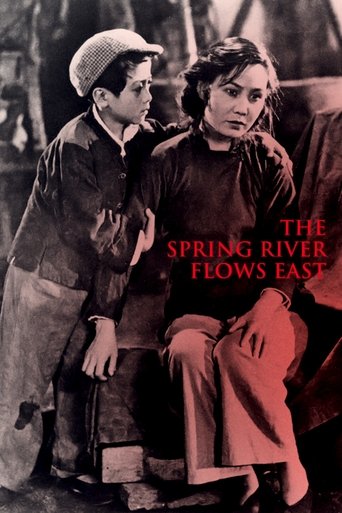
The Spring River Flows East (1947)
一江春水向东流
1930's China. The village of a poor family is taken over by the occupying Japanese army. One son, Zhongliang, leaves his wife and young son to join a medic group for the Chinese Army. The other son, Zhangmin goes into hiding to protect his family. The focus shifts back and forth from the brothers' parents and Zhongliang's wife and son to Zhongliang's newfound life of luxury in a town not too far away. The plight of Zhongliang's mother, his wife, Sufan and her son, Kongeson is contrasted with Zhongliang's rise in a flourishing company.
- Date of release
- 1947-10-09
- TMDB
- 6.7 / 10 (11)
- Runtime
- 3h 12m
- Genres
- Drama
- Director
- Zheng Jun-li, Chusheng Cai
Casting
- Yang Bai — Sufen
- Tao Jin — Zhongliang Zhang
- Wu Yin — Mother-in-law
- Shangguan Yunzhu — Wenyuan He
- Shu Xiuwen — Lizheng Wang
- Boxun Zhou — Haogong Pang
- Gongshang Yan
- Xia Tian — Old Gong
- Shi Lin — 何大婶
- Gao Zheng — Zhongmin Zhang
- Lam Wah
- Lu Yue
Interesting facts
The Spring River Flows East, also translated as The Tears of Yangtze, is a 1947 epic Chinese film written and directed by Cai Chusheng and Zheng Junli and produced by the Kunlun Film Company. It is considered one of the most influential and extraordinary Chinese films ever made, and China's equivalent of Gone with the Wind. With both films based on the story of war and chaos, they contain an epic style considered classics in the film history of both China and the United States. The Hong Kong Film Awards ranked it in its list of greatest Chinese-language films ever made at number 27.
Production
“At Kunlun, production appeared to have been arranged around the director as the principal authority who delegated tasks. However, scenario writer and director committees were established as a critical forum to check the abuse of directorial power.”
The film was released on the eve of the Double Tenth in Shanghai, the anniversary of the Wuchang Uprising in 1911. The Double Tenth is shown in both parts of the film, highlighting key narrative points. During February 1947, one of the film's sponsors, Zhang Naiqi, disinvested in the film's production due to political turmoil.
By using montage techniques, the editing of this film builds up stark contrast between male and female characters, clearly showing the gender confrontation to the public. While the male characters dominate the public space - rushing off to war and being present on a national level, the women are centered in a much more domestic space.
These montage techniques are utilized during the war scenes as well. Shooting a war scene on location would be too expensive, so the directors creatively used newsreel footage alongside footage shot on studio sets, finding ways through montage sequences highly influenced by Russian director Sergei Eisenstein, to re-create credible visuals within their minimalist budget.
From April 1941 to December of the same year, a newspaper company, China Business News (Hua Shang Bao), opened its business and embarked on movie production in Hong Kong. However, during this period, Hong Kong under British control would be handed over to Japan by the government rather than to the Communist party. Therefore, British government was eager to suppress anti-Japanese criticism.
Read on Wikipedia · Text from Wikipedia, CC BY-SA 4.0. Data from Wikidata.
Recommended
- Devils on the Doorstep 2001 · ★ 8.2
- Hidden Blade 2023 · ★ 6.3
- The Eight Hundred 2020 · ★ 7.0
- The Wasted Times 2016 · ★ 6.8
- The Flowers of War 2011 · ★ 7.4
- The Children of Huang Shi 2008 · ★ 6.7
- Empire of the Sun 1987 · ★ 7.5
- The Inn of the Sixth Happiness 1958 · ★ 6.8
- Shanghai 2010 · ★ 6.1
- Xiu Xiu: The Sent-Down Girl 1998 · ★ 7.2
- The Message 2009 · ★ 7.4
- The Battle at Lake Changjin 2021 · ★ 6.4