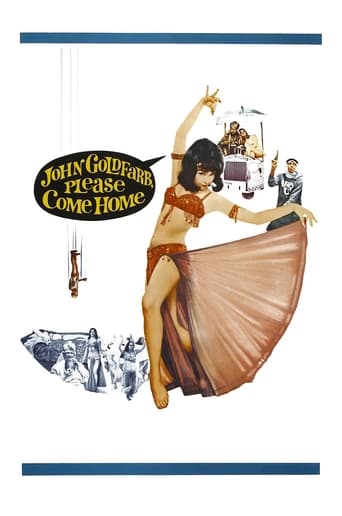
John Goldfarb, Please Come Home! (1965)
A Wild Whirl of Wacky Fun!
During the Cold War, John Goldfarb crashes his spy plane in the Middle East and is taken prisoner by the local government. His captor, King Fawz, soon discovers that Goldfarb used to be a college football star. So he issues him an ultimatum: coach his country's football team, or Fawz will surrender him to the Russians. Goldfarb teams up with undercover reporter Jenny Ericson, and together they plot to escape their dangerous situation.
- Date of release
- 1965-03-24
- TMDB
- 3.8 / 10 (10)
- Runtime
- 1h 36m
- Genres
- Comedy
- Director
- J. Lee Thompson
Casting
- Shirley MacLaine — Jenny
- Peter Ustinov — Fawz
- Richard Crenna — John Goldfarb
- Jim Backus — Whitepaper
- Scott Brady — Sakalakis
- Fred Clark — Overreach
- Wilfrid Hyde-White — Guz
- Harry Morgan — Sarajevo
- Patrick Adiarte — Ammud
- Richard Deacon — Maginot
- Jerome Cowan — Brinkley
- Leon Askin — Samir
Interesting facts
- Based on: John Goldfarb, Please Come Home!
- Filmed in: California
John Goldfarb, Please Come Home! is a 1965 American comedy film based on the novel by William Peter Blatty published in 1963. The film was directed by J. Lee Thompson. The film was shot in the Mojave Desert.
Production
In September 1963, Hedda Hopper reported Arthur Jacbos and J. Lee Thompson were reading the book. Jacobs and Thompson had made What a Way to Go with Shirley MacLaine at 20th Century Fox, which had been a hit. Fox agreed to finance Goldfarb.
The film was budgeted at $4.5 million and, like What a Way to Go, was mostly shot on the Fox backlot. There was location filming in the Mojave Desert in May.
Montgomery Clift was reportedly offered a lead role and turned it down, even though he was not being offered much work at the time, because he disliked the script.
Thompson had been unable to find a male star, and eventually went with Richard Crenna, then best known for his work on The Real McCoys. Fox took an option on his services for three more movies.
Hedda Hopper saw a preview in November 1964 and called it a "waste of money and actors." She later wrote Thompson "went hog wild" on the film. Representatives from Notre Dame also saw a preview on 17 November. This was to have major ramifications for the movie.
Read on Wikipedia · Text from Wikipedia, CC BY-SA 4.0. Data from Wikidata.
Recommended
- Balls Up 2026 · ★ 5.8
- The Cheerleaders 1973 · ★ 6.0
- The Phoenician Scheme 2025 · ★ 6.5
- The Wrecking Crew 2026 · ★ 7.1
- Fanboys 2009 · ★ 6.2
- The Game Plan 2007 · ★ 6.5
- Sextuplets 2019 · ★ 6.2
- Detroit Rock City 1999 · ★ 6.8
- Back to the Future Part II 1989 · ★ 7.8
- Central Intelligence 2016 · ★ 6.4
- The Union 2024 · ★ 6.0
- Top Secret! 1984 · ★ 7.1