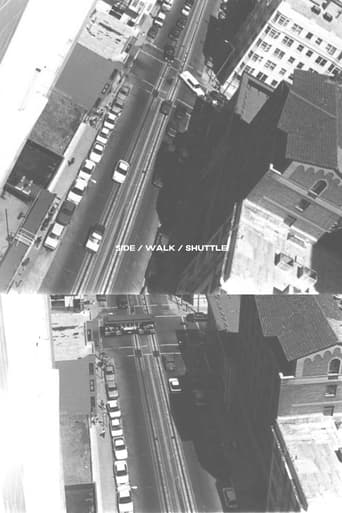
Side/Walk/Shuttle (1992)
Meditation. Architecture. Urban Spaces.
In this infamous structural film, Ernie Gehr takes to the glass elevator attached to San Francisco's Fairmont Hotel and rides its 24 stories up and down, constantly shifting the orientation of his camera to offer images of the city as a zone of constant flux, freed from gravity and in perpetual rearrangement.
- Date of release
- 1992-10-05
- TMDB
- 6.7 / 10 (12)
- Runtime
- 41m
- Genres
- Documentary
- Director
- Ernie Gehr
Interesting facts
Side/Walk/Shuttle is a 1991 American avant-garde film directed by Ernie Gehr. It shows downtown San Francisco as seen at different angles from a moving elevator.
Production
Gehr made the film shortly after moving to San Francisco. Filming took place over the course of nearly a year at the Fairmont Hotel in San Francisco. He was interested in the topography of the city, and his process as shaped by "reflections on a lifetime of displacement, moving from place to place and haunted by recurring memories of other places [he] once passed through." He chose the location aware of its close proximity to where Eadweard Muybr…
The building had a glass elevator leading to a restaurant at the top, from which Gehr shot the entire film. He began by riding up and down the elevator, making notes and sketches about the angles at which he could position the camera. He filmed between 12:00 p.m. and 1:30 p.m. to minimize reflections on the elevator glass and shadows cast by surrounding buildings. Gehr filmed without asking permission from the hotel, not expecting to need it.
When Gehr edited the film, he spliced in some of the shots backward. This had the effect of not only flipping the orientation of the image in the film, but reversing the direction of the elevator in the shot and the movement of any objects visible at ground level. The soundtrack was created from cassette recordings Gehr had made in Grand Central Station in New York City, Geneva, Venice, London, and Berlin.
Read on Wikipedia · Text from Wikipedia, CC BY-SA 4.0. Data from Wikidata.
Recommended
- Avatar: The Deep Dive - A Special Edition of 20/20 2022 · ★ 7.2
- A Toxic Love Story 2026 · ★ 6.4
- McQueen 2018 · ★ 7.4
- Directed by John Ford 1971 · ★ 7.0
- Come See Me in the Good Light 2025 · ★ 7.1
- The Class of ‘92 2013 · ★ 7.1
- Seduced and Abandoned 2013 · ★ 6.2
- Above Majestic 2018 · ★ 7.4
- Elstree 1976 2015 · ★ 6.2
- Anna Nicole Smith: You Don't Know Me 2023 · ★ 6.1
- S4: The Bob Lazar Story 2026 · ★ 8.4
- Capital in the Twenty-First Century 2019 · ★ 6.5