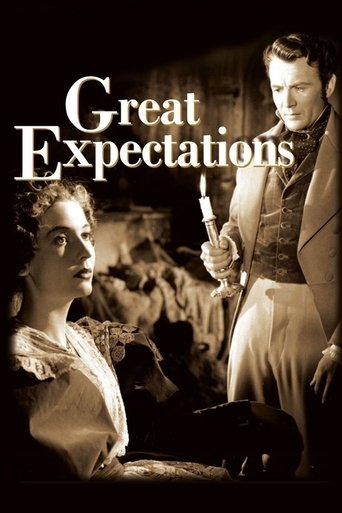
Great Expectations (1946)
From the Vivid Pages of Charles Dickens' Masterpiece!
In this Dickens adaptation, orphan Pip discovers through lawyer Mr. Jaggers that a mysterious benefactor wishes to ensure that he becomes a gentleman. Reunited with his childhood patron, Miss Havisham, and his first love, the beautiful but emotionally cold Estella, he discovers that the elderly spinster has gone mad from having been left at the altar as a young woman, and has made her charge into a warped, unfeeling heartbreaker.
- Date of release
- 1946-12-26
- TMDB
- 7.3 / 10 (394)
- Runtime
- 1h 58m
- Genres
- Drama, Romance
- Director
- David Lean
Casting
- John Mills — Pip
- Valerie Hobson — Estella
- Tony Wager — Young Pip
- Jean Simmons — Young Estella
- Bernard Miles — Joe Gargery
- Francis L. Sullivan — Mr. Jaggers
- Finlay Currie — Abel Magwitch
- Martita Hunt — Miss Havisham
- Alec Guinness — Herbert Pocket
- Ivor Barnard — Mr. Wemmick
- Freda Jackson — Mrs. Joe
- Eileen Erskine — Biddy
Interesting facts
- Based on: Great Expectations
- Filmed in: Pinewood Studios
- Awards: 3 · Nominations: 5. Including: Academy Award for Best Cinematography, Black-and-White; Academy Award for Best Art Direction, Black and White; National Board of Review: Top Ten Films
Great Expectations is a 1946 British drama film directed by David Lean, inspired by the 1861 novel by Charles Dickens and starring John Mills and Valerie Hobson. The supporting cast included Bernard Miles, Francis L. Sullivan, Anthony Wager, Jean Simmons, Finlay Currie, Martita Hunt and Alec Guinness.
Production notes
Alec Guinness admired the way Lean directed him, singling out a close-up in which he had to laugh out loud, and which he struggled to make look un-manufactured. Lean told him to forget about the whole thing, sat by his side, and made a little signal to the camera to start turning in the course of the conversation. He said something which made Guinness laugh and then said, "Cut". Guinness: "So he got this shot on a totally false premise...
At the end of the film, a shot of Valerie Hobson staring into a mirror was taking longer than anticipated and was suspended – it was lunchtime – and returned to in the afternoon. Later, some three months after the film had been on exhibition, a cinema-goer asked what was meant by a Chad being reflected in the mirror.
The musical score is credited to Walter Goehr, known primarily as a conductor, but significant portions were actually written by Kenneth Pakeman.
Read on Wikipedia · Text from Wikipedia, CC BY-SA 4.0. Data from Wikidata.
Recommended
- Great Expectations 2012 · ★ 6.4
- Oliver Twist 2005 · ★ 6.8
- Oliver Twist 1948 · ★ 7.6
- A Room with a View 1986 · ★ 6.9
- Breathe 2017 · ★ 7.4
- Labor Day 2013 · ★ 7.1
- Sweetness in the Belly 2019 · ★ 6.2
- Untamed Heart 1993 · ★ 6.9
- The Duchess 2008 · ★ 7.0
- The Man from Elysian Fields 2001 · ★ 5.9
- Me Before You 2016 · ★ 7.9
- Victoria & Abdul 2017 · ★ 6.9