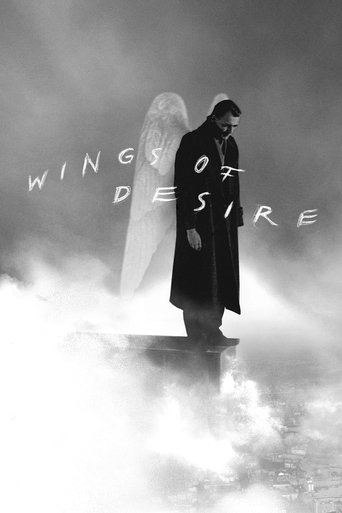
Wings of Desire (1987)
Der Himmel über Berlin
There are angels on the streets of Berlin.
Two angels, Damiel and Cassiel, glide through the streets of Berlin, observing the bustling population, providing invisible rays of hope to the distressed but never interacting with them. When Damiel falls in love with lonely trapeze artist Marion, the angel longs to experience life in the physical world, and finds — with some words of wisdom from actor Peter Falk — that it might be possible for him to take human form.
- Date of release
- 1987-09-23
- TMDB
- 7.8 / 10 (1571)
- Runtime
- 2h 8m
- Genres
- Drama, Fantasy, Romance
- Director
- Wim Wenders
- Collection
- Damiel and Cassiel Collection
Casting
- Bruno Ganz — Damiel
- Solveig Dommartin — Marion
- Otto Sander — Cassiel
- Curt Bois — Homer
- Peter Falk — The Filmstar
- Hans Martin Stier — The Dying Man
- Elmar Wilms — A Sad Man
- Sigurd Rachman — The Suicide
- Beatrice Manowski — Young Prostitute
- Bruno Rosaz — The Clown
- Laurent Petitgand — The Bandleader
- Chick Ortega — The Drummer
Interesting facts
- Box office: $3.4M
- Filmed in: West Berlin
- Awards: 4 · Nominations: 5. Including: Film Independent Spirit Awards; Kurd Lasswitz Award for Best Foreign Work; European Film Award for Best Director; European Film Award for Best Supporting Actor
Wings of Desire is a 1987 romantic fantasy film written by Wim Wenders, Peter Handke and Richard Reitinger, and directed by Wenders. The film is about invisible, immortal angels who populate Berlin and listen to the thoughts of its human inhabitants, comforting the distressed. Even though the city is densely populated, many of the people are isolated or estranged from their loved ones. One of the angels, played by Bruno Ganz, falls in love with a beautiful, lonely trapeze artist, played by Solveig Dommartin.
Production
After living and working in the United States for eight years, director Wim Wenders returned to his native West Germany and wished to reconnect to it with a film about his favourite part of it, West Berlin. Planning to make Until the End of the World in 1985, he realised the project would not be ready for two years, and wishing to return to photography as soon as possible, he considered another project.
Rainer Maria Rilke's poetry partially inspired the story. Wenders claimed angels seemed to dwell in Rilke's poetry, and the director had also jotted "angels" in his notes one day, and noted angel-themed artwork in cemeteries and around Berlin. In his treatment, Wenders also considered a backstory in which God exiled his angels to Berlin as punishment for defending humans after 1945, when God had decided to forsake them.
Wenders employed Peter Handke, who wrote much of the dialogue, the poetic narrations, and the film's recurring poem "Song of Childhood". Wenders found the names Damiel and Cassiel in an encyclopedia about angels, and also had photographs of Solveig Dommartin, Bruno Ganz and Otto Sander that served as muses. The idea that angels could read minds led to Wenders considering personal dialogue no one would say aloud.
Given the nature of this arrangement, Wenders would hold daily meetings with his crew, frequently at late hours, to plan the logistics for the following day. French producer Anatole Dauman did not see a large budget as necessary, and the project was funded with 5 million DM.
Wenders believed it would be important for the actors playing the two main angel characters to be familiar and friendly with each other. Ganz and Sander had performed in some of the same stage productions for 20 years. Sander and Ganz also recommended Curt Bois to Wenders and asked Bois to perform. Bois' performance as Homer marked his final feature film in an 80-year career, beginning as a child actor.
Read on Wikipedia · Text from Wikipedia, CC BY-SA 4.0. Data from Wikidata.
Recommended
- City of Angels 1998 · ★ 6.8
- Meet Joe Black 1998 · ★ 7.4
- Undine 2020 · ★ 6.5
- The Age of Adaline 2015 · ★ 7.5
- A Ghost Story 2017 · ★ 7.1
- All Dogs Go to Heaven 2 1996 · ★ 6.1
- Heart of Stone 2016 · ★ 6.2
- Skellig 2009 · ★ 6.2
- What if... 2010 · ★ 6.8
- A Heavenly Christmas 2016 · ★ 6.1
- When Nietzsche Wept 2007 · ★ 6.1
- What Dreams May Come 1998 · ★ 7.3