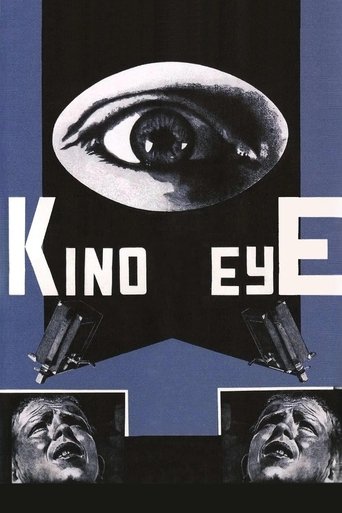
Kino-Eye (1924)
Киноглаз
Promoting the joys of life in a Soviet village centering on the activities of the Young Pioneers. These children are constantly busy, pasting propaganda posters on walls, distributing hand bills, exhorting all to 'buy from the cooperative' as opposed to the Public Sector, promoting temperance, and helping poor widows. Experimental portions, projected in reverse, feature the un-slaughtering of a bull and the un-baking of bread.
- Date of release
- 1924-10-31
- TMDB
- 6.7 / 10 (46)
- Runtime
- 1h 18m
- Genres
- Documentary
- Director
- Dziga Vertov
Interesting facts
Kino-Eye is a 1924 Soviet silent documentary film directed by Dziga Vertov and shot by cinematographer Mikhail Kaufman. This experimental film, which laid the groundwork for Vertov's principles of documentary filmmaking, received mixed reviews from critics and film scholars.
Production
While preparing the proposal for Kino-Eye, Dziga Vertov wrote that it would be the world's first film shot without actors, costume designers, set designers, or makeup artists; as a director, he would not need studio soundstages or sets, because the film's characters would exist in real life.
In 1923, four members of the film crew arrived in the village of Pavlovskoye. The filmmakers were drawn to this area not only because of the picturesque landscapes of the Istra, but also because one of the first Young Pioneer camps in the USSR was located on the riverbank.
Vertov's crew stayed in Pavlovskoye and traveled to the pioneer camp every morning. The filmmakers urged children and adults alike not to pay any attention to them; the filming took place in a natural setting, without any staged scenes. The film, widely regarded as experimental and shot in accordance with Dziga Vertov's theory of "life caught unawares", was released in 1924.
Read on Wikipedia · Text from Wikipedia, CC BY-SA 4.0. Data from Wikidata.
Recommended
- Sherman's March 1986 · ★ 6.3
- The Soviet Story 2008 · ★ 7.3
- Fuck 2006 · ★ 6.4
- In the Realms of the Unreal 2004 · ★ 7.2
- Come See Me in the Good Light 2025 · ★ 7.1
- The Captains 2011 · ★ 6.4
- Heart of a Dog 2015 · ★ 6.5
- Naqoyqatsi 2002 · ★ 6.2
- Vampir Cuadecuc 1972 · ★ 6.1
- Elstree 1976 2015 · ★ 6.2
- Directed by John Ford 1971 · ★ 7.0
- S4: The Bob Lazar Story 2026 · ★ 8.4