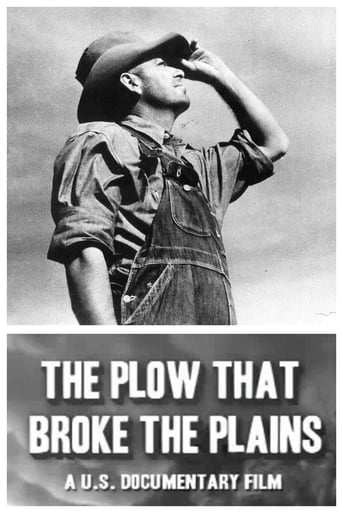
The Plow That Broke the Plains (1936)
A documentary about what happened to the Great Plains of the United States and Canada when uncontrolled farming destroyed the soil and led to the Dust Bowl.
- Date of release
- 1936-05-10
- TMDB
- 5.8 / 10 (18)
- Runtime
- 25m
- Genres
- Documentary
- Director
- Pare Lorentz
Casting
- Thomas Chalmers — Narrator (voice)
- Bam White — Farmer
Interesting facts
- Budget: $20K
- Filmed in: Kern County, Texas Panhandle, and Dalhart
The Plow That Broke the Plains is a 1936 short documentary film that shows the cultivation of the Great Plains region of the United States and Canada following the Civil War and leading up to the Dust Bowl as a result of exploitation of the Great Plains' natural resources.The Plow That Broke the Plains was the first film created by the US government for commercial release and distribution through the Resettlement Administration as part of President Roosevelt's New Deal program.
Production
The early production period, which consisted of Pare Lorentz conducting research and developing a rough shooting script lasted from June to September 1935. To make the film as inexpensive as possible, Lorentz did not use any professional actors and shot all footage on location. Because sound technology was still new, bringing the equipment into the field to capture human voices and sounds would have been nearly impossible.
Over the next 7 weeks, Lorentz and his cameramen traversed eight states from the Montana-Wyoming border to the Texas Panhandle. Because The Plow That Broke the Plains was Lorentz's first film, he had difficulty communicating his ideas to the cameramen and filming locations became a point of contention between Lorentz and the crew. Additionally, the cameramen became concerned that the final script had not yet been written either.
The Resettlement Administration proposed to have The Plow That Broke the Plains produced and accompanied with music at an estimated expense of $6,000. Despite the budget allotted to film production, there were times that he worked without pay due to Congress debating whether or not the film should be created. Although Lorentz was salaried, he made only $18 a day, which was less than the cameramen working on the project.
In order to engage the audience, Lorentz had to condense the history of the Great Plains into a simplified "ecological drama" that would elicit a strong emotional response. Lorentz wrote the script following filming, with narration in a free verse that utilized a Walt Whitman-like repetition of words and phrases to create a mood of judgement.
Read on Wikipedia · Text from Wikipedia, CC BY-SA 4.0. Data from Wikidata.
Recommended
- A Toxic Love Story 2026 · ★ 6.5
- Harmontown 2014 · ★ 6.6
- No Half Measures: Creating the Final Season of Breaking Bad 2013 · ★ 8.6
- Downloaded 2013 · ★ 6.5
- Naqoyqatsi 2002 · ★ 6.2
- Avatar: The Deep Dive - A Special Edition of 20/20 2022 · ★ 7.2
- The Class of ‘92 2013 · ★ 7.1
- We Live in Public 2009 · ★ 6.8
- The Crystal Calls - Making The Dark Crystal: Age of Resistance 2019 · ★ 7.5
- To Kill a Tiger 2023 · ★ 7.6
- Champs 2015 · ★ 6.4
- Anna Nicole Smith: You Don't Know Me 2023 · ★ 6.1