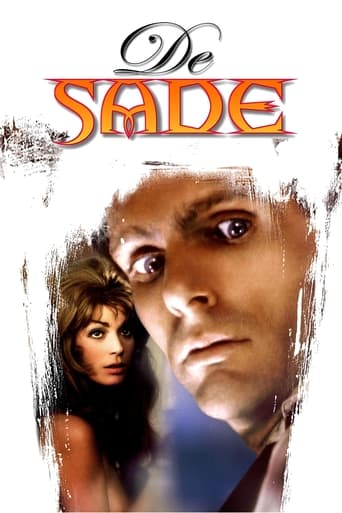
De Sade (1969)
He made evil an art, virtue a vice... and pain a pleasure!
The 18th-century French marquis recalls his sadomasochistic experiments and goes to jail for lewd behavior.
- Date of release
- 1969-08-27
- TMDB
- 3.4 / 10 (18)
- Runtime
- 1h 53m
- Genres
- Drama, History, Thriller
- Director
- Cy Endfield
Casting
- Keir Dullea — Marquis de Sade
- Senta Berger — Anne de Montreuil
- Lilli Palmer — Mme. de Montreuil
- Anna Massey — Renée de Montreuil
- Sonja Ziemann — La Beauvoisin
- Christiane Krüger — Laura
- Uta Levka — Rose Keller
- Barbara Stanek — Colette
- Susanne von Almassy — Marquis' Mother
- Friedrich Schoenfelder — Marquis' Father
- Herbert Weißbach — M. de Montreuil
- Heinz Spitzner — Inspector Marais
Interesting facts
- Filmed in: Berlin and Bavaria
De Sade is a 1969 American-German drama film directed by Cy Endfield and starring Keir Dullea, Senta Berger and Lilli Palmer. It is based on the life of Donatien Alphonse François, Marquis de Sade, named Louis Alphonse Donatien in the film.
Production
AIP announced they would make the film in 1967 to be based on Theatre of Horrors, an unpublished novel by Louis M. Heyward.
Roger Corman worked on the first draft of the script with Richard Matheson but was dissatisfied and told James H. Nicholson of AIP he was going off the project. "I thought the picture was a trap," said Corman. "If we tried to show what de Sade did, or as Dick Matheson and I did, some of his fantasies, or more specifically what de Sade did in his fantasies, we'd be arrested. And if we didn’t show it, the audience was going to be cheated.
Among the original directors discussed for the film were Michael Reeves and Gordon Hessler. The film was also to have been produced by Hessler. Hessler later said "I never really worked on that film. The director was to have been Michael Reeves, but he was ill and I could not get along with Cy Endfield who replaced him. Deke Heyward suggested I do Murders in the Rue Morgue instead." Cy Endfield became director.
According to Matheson, "For some reason when Cy Endfield directed it he decided not to do it as a fantasy, and yet keep incidents in the script as they were, which made it absolutely incomprehensible." During production it was announced that AIP would make De Sade and also Justine from the novel by De Sade. The film's budget was announced at $6 million.
The film was shot at Spandau Studios in Berlin and Bavaria Studios in Munich. The film's sets were designed by the art director Hans Jürgen Kiebach. Matheson said Endfield "who was apparently having some mental problems at the time, would X out pages of the script which would indicate to the studio that the pages had been shot, and they had not been shot.
Read on Wikipedia · Text from Wikipedia, CC BY-SA 4.0. Data from Wikidata.
Recommended
- Firebrand 2024 · ★ 6.3
- The Secrets We Keep 2020 · ★ 6.0
- Prizefighter: The Life of Jem Belcher 2022 · ★ 6.2
- Fanny Lye Deliver'd 2019 · ★ 6.3
- All Eyez on Me 2017 · ★ 6.7
- Lockdown 2000 · ★ 6.1
- Dalíland 2022 · ★ 5.9
- Run 1991 · ★ 6.0
- The Devil's Double 2011 · ★ 6.7
- Above the Rim 1994 · ★ 7.1
- SAS: Red Notice 2021 · ★ 5.8
- The Operative 2019 · ★ 5.8