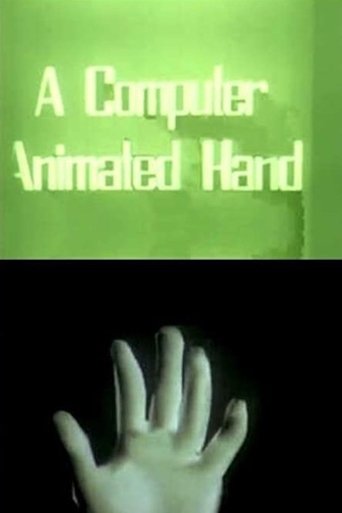
A Computer Animated Hand (1972)
Archive film showing possibly the first example of digital rendering, made by Pixar co-founders Ed Catmull and Fred Parke in 1972, was stumbled upon by the son of Robert B Ingebretsen, who also set up the world-famous U.S. studio. A six minute version shows additional CGI animation of an artificial heart valve, and human heads.
- Date of release
- 1972-12-31
- TMDB
- 6.6 / 10 (21)
- Runtime
- 6m
- Genres
- Documentary, Animation
- Director
- Edwin Catmull, Fred Parke
Interesting facts
A Computer Animated Hand is a 1972 American computer-animated short film produced by Edwin Catmull and Fred Parke. Produced during Catmull's tenure at the University of Utah, the brief was created as part of a graduate course project. After making a model of his left hand, 350 triangles and polygons were drawn in ink on its surface. The model was digitized from the data and laboriously animated in a three-dimensional animation program that Catmull wrote.
Production
Catmull hoped as a child to become a Disney animator, but reversed his ideas in high school, ruefully concluding he lacked the ability to draw. He graduated from the University of Utah in 1969 with degrees in computer science and physics, and took a job at Boeing shortly afterward. His position was soon terminated in a mass layoff along with thousands of other employees.
Fred Parke, a fellow Ph.D. student in his class who helped produce the film, recalled that computer animation was "sort of on the lunatic fringe at that time. [...] People were just barely to the point where they could get a computer to put out still images." It was obvious that it would take years for the state-of-the-art in computer hardware to catch up with this ambition, and there were multiple problems on the mathematical and programming sid…
Catmull used his left hand as the basis for the clip, first creating a model of it. He began making a plaster-of-Paris mold of his hand and accidentally pulled off the hair on the back of his hand while removing the mold. He then made a plaster model from the mold and drew 350 small triangles and polygons on the model in ink. Digital counterparts of these polygons would represent the surface of his hand in the computer.
Catmull and Parke spent a considerable amount of time crafting the film, measuring the coordinates of each corner point of the polygons, and typing them into the machine using a Teletype keyboard. With a 3-D animation program that Catmull wrote, they could reproduce the disembodied hand on a screen and make it move. During this time, Parke had also created a computer animation of his wife's face, which is seen in the film.
Transferring the images to film was a task in itself. Because the display hardware never showed the entire image on screen at any one moment, Catmull could see a frame of his work only by taking a long-exposure Polaroid of the screen and looking at the snapshot. Once satisfied, he then shot the footage using a 35mm camera the department rigged to take photographs from a CRT screen.
Read on Wikipedia · Text from Wikipedia, CC BY-SA 4.0. Data from Wikidata.
Recommended
- Who Are You, Charlie Brown? 2021 · ★ 6.9
- Beyond Infinity: Buzz and the Journey to Lightyear 2022 · ★ 7.0
- Piece by Piece 2024 · ★ 7.1
- The Pixar Story 2007 · ★ 7.6
- As I Was Moving Ahead Occasionally I Saw Brief Glimpses of Beauty 2000 · ★ 7.8
- 42 Up 1999 · ★ 7.6
- Aquaman: Heroines of Atlantis 2019 · ★ 6.2
- The Curious Birth of Benjamin Button 2009 · ★ 7.0
- Frank and Ollie 1995 · ★ 7.4
- Embrace the Panda: Making Turning Red 2022 · ★ 6.8
- Stan Lee 2023 · ★ 7.2
- Another Day of Life 2018 · ★ 7.4