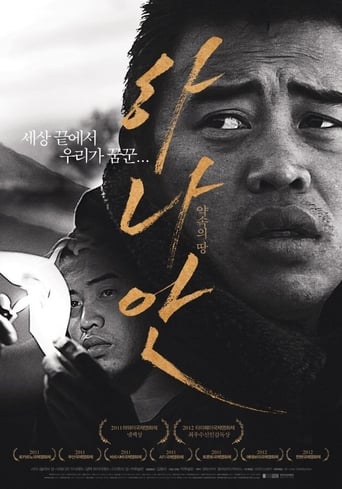
하나안 (2012)
Stas is a young third generation Koryo-saram, a member of the Korean minority in Central Asia that was deported from the Russian Far East by Stalin. He and his three friends Kasoy, Shin and Said try to escape from the grim life in Tashkent, the Uzbek capital, and one day, they also try heroin. Then, however, Kasoy gets killed by a gang. 6 years later, Shin has emigrated to South Korea, Said has become a drug addict and Stas is now a police officer. Said commits suicide by overdosing and Stas, who has has since then also become a drug addict, decides to turn over a new leaf. He follows Shin to South Korea, but can this be Hanaan for him, the Promised Land?
- Data di uscita
- 2012-10-11
- TMDB
- 7.0 / 10 (5)
- Durata
- 1 h 28 min
- Generi
- Dramma, Crime
- Regista
- Руслан Пак
Cast
- Stanislav Tyan — Stas
- Bahodir Musaev — Said
- Dmitry Eum — Kasoy
- Ilbek Faiziev — Maha
- Руслан Пак — Shin
- 김꽃비 — Olga (Special Appearance)
- Vyacheslav Czyu — Korean Guy
- Rustam Esanov — Drug Addict
- Anastasiya Ham — Little Girl
- Faizullo Askarov — Baha
- Vosid Ibragimov — Guy in Maha's Car
- Shahboz Hurramov — Guy in Maha's Car
Curiosità
Hanaan is a 2011 Uzbek-South Korean drama film by director Ruslan Pak.
Development
Korean people were forced to migrate from eastern Russia to Central Asia in 1937. This led to a diaspora population called Koryo-saram in areas like Uzbekistan and Kazakhstan that persists. Due to a combination of Soviet assimilationist policies and necessity, Koryo-saram rapidly forgot the Korean language. Despite this, they still maintained a significant ethnic identity.
Around 2017, the South Korean Ministry of Foreign Affairs reported that there were around 500,000 ethnic Koreans in the former Soviet Union (Commonwealth of Independent States). Uzbek Koreans are the largest group, with a population of around 150,000.
Due to a revision of the 1999 Overseas Koreans Act in 2004, Uzbeks began repatriating to South Korea at greater rates. In 2017, among foreign nationals living in South Korea, Koryo-saram with Uzbek citizenship formed the third largest group, followed by Koreans with Chinese citizenship and Korean Americans.
Director Ruslan Pak grew up in a household that did not speak Korean. As a child, he learned the Korean martial art taekwondo and Korean, which created a heimat, an idealized image of his ancestral homeland, in his mind. Pak enrolled in a film studies course at the Graduate School of the Korea National University of Arts in Seoul in 2006, and produced this film as his graduation work.
Like many other Koryo-saram who visit South Korea, Pak had mixed feelings his experience. He said in an interview, "I began learning Korean in search of my identity, but I felt disappointed when I actually came to Korea. I didn't feel embraced by the society". Many ended up returning to Uzbekistan. Of the issue of identity, Pak said:
Leggi su Wikipedia · Testo da Wikipedia, CC BY-SA 4.0. Dati da Wikidata.
Consigliati
- Il ladro 1997 · ★ 7.1
- Và e uccidi 1962 · ★ 7.5
- The Nest - L'inganno 2020 · ★ 6.1
- Flicka - Uno spirito libero 2006 · ★ 6.9
- Un'improbabile amicizia 2019 · ★ 6.7
- Vola più in alto 1994 · ★ 7.1
- Minari 2020 · ★ 7.3
- Sguardo nel vuoto 2007 · ★ 6.6
- La vita futura 1936 · ★ 6.4
- Icefall - Caccia sul ghiaccio 2025 · ★ 6.6
- Black Site – La tana del lupo 2022 · ★ 6.0
- Jawbone 2017 · ★ 6.1