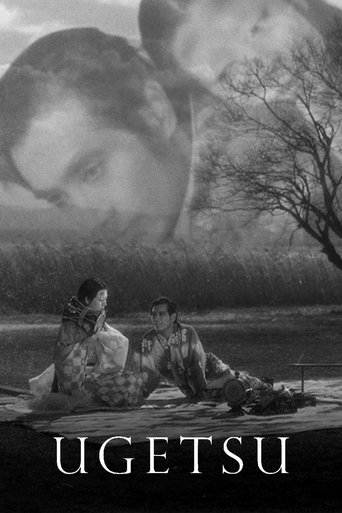
Ugetsu (1953)
雨月物語
In 16th century Japan, peasants Genjuro and Tobei sell their earthenware pots to a group of soldiers in a nearby village, in defiance of a local sage's warning against seeking to profit from warfare. Genjuro's pursuit of both riches and the mysterious Lady Wakasa, as well as Tobei's desire to become a samurai, run the risk of destroying both themselves and their wives, Miyagi and Ohama.
- Date of release
- 1953-03-26
- TMDB
- 8.0 / 10 (677)
- Runtime
- 1h 36m
- Genres
- Fantasy, Drama, Mystery
- Director
- Kenji Mizoguchi
Casting
- Machiko Kyō — Lady Wakasa
- Mitsuko Mito — Ohama
- Kinuyo Tanaka — Miyagi
- Masayuki Mori — Genjurô
- Eitarō Ozawa — Tôbei
- Sugisaku Aoyama — Old Priest
- Mitsusaburō Ramon — Captain of Tamba Soldiers
- Ryōsuke Kagawa — Village Master
- Kichijirō Ueda — Shop Owner
- Shōzō Nanbu — Shintô Priest
- Kikue Mōri — Ukon
- Ryūzaburō Mitsuoka — Soldier
Interesting facts
- Based on: Tales of Moonlight and Rain
- Filmed in: Japan
- Awards: 1 · Nominations: 1. Including: Silver Lion
Ugetsu is a 1953 Japanese period fantasy film directed by Kenji Mizoguchi starring Masayuki Mori and Machiko Kyō. It was written by Matsutarō Kawaguchi and Yoshikata Yoda based on the stories "The House in the Thicket" and "The Lust of the White Serpent" from Ueda Akinari's 1776 book Ugetsu Monogatari, combining elements of the jidaigeki genre with a ghost story.
Production
After the success of his previous film The Life of Oharu (1952), Mizoguchi was offered to make a film by his old friend Masaichi Nagata at Daiei Film studios. The deal promised Mizoguchi complete artistic control and a large budget. Despite this, Mizoguchi was eventually pressured to make a less pessimistic ending for the film.
Mizoguchi based his film on two stories from Ueda's book, "The House in the Thicket" (Asaji ga Yado) and "The Lust of the White Serpent" (Jasei no In). "The Lust of the White Serpent" is about a demon who appears as a princess and attempts to seduce a man. It was the basis of the plot in which Lady Wakasa seduces Genjūrō.
Despite initial intentions, as the film developed, Yoda said anti-war messages, particularly about how war makes women suffer, kept surfacing and soon became the most prominent theme. While writing the script, Mizoguchi told Yoda "Whether war originates in the ruler's personal motives, or in some public concern, how violence, disguised as war, oppresses and torments the populace both physically and spiritually ...
The film was Machiko Kyō's second collaboration with Mizoguchi, as she had a small role in The Three Danjuros (1944). She had collaborated much more frequently with Masayuki Mori. As Lady Wakasa, Kyō's costume was modeled after fashion before the Edo period and her face was designed to appear similar to a mask common in Noh theatre. As such, her eyebrows were styled using a practice known as hikimayu.
Kinuyo Tanaka, who played Miyagi, found the scene where she is a ghost to be the most stressful, as she had to play a ghost and appear to be an actual wife at the same time. After rehearsals and the shooting, Mizoguchi lit a cigarette for Mori, indicating his rare degree of satisfaction with the scene.
Read on Wikipedia · Text from Wikipedia, CC BY-SA 4.0. Data from Wikidata.
Recommended
- Mononoke the Movie: The Phantom in the Rain 2024 · ★ 7.3
- The Girl from the Other Side 2023 · ★ 7.8
- 47 Ronin 2013 · ★ 6.2
- Rascal Does Not Dream of a Knapsack Kid 2023 · ★ 7.7
- The Mortal Instruments: City of Bones 2013 · ★ 6.4
- Mio in the Land of Faraway 1987 · ★ 6.0
- Fate/Grand Order the Movie: Divine Realm of the Round Table: Camelot 1 Wandering; Agateram 2020 · ★ 7.0
- Detective Conan: The Last Wizard of the Century 1999 · ★ 7.4
- Berserk: The Golden Age Arc I - The Egg of the King 2012 · ★ 7.3
- The Good Witch 2008 · ★ 7.1
- The Good Witch's Family 2011 · ★ 7.3
- Bleach the Movie: Fade to Black 2008 · ★ 7.2