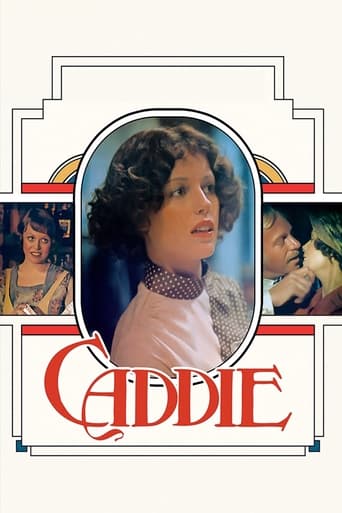
Caddie (1976)
She's loved, dumped, kissed and kicked around... but mostly loved.
Proud and classy Caddie Marsh is forced to get a job as a barmaid and raise two children on her own after her husband walks out on her.
- Date of release
- 1976-01-01
- TMDB
- 6.2 / 10 (6)
- Runtime
- 1h 40m
- Genres
- Romance, Drama
- Director
- Donald Crombie
Casting
- Helen Morse — Caddie Marsh
- Takis Emmanuel — Peter
- Jack Thompson — Ted
- Jacki Weaver — Josie
- Melissa Jaffer — Leslie
- Ron Blanchard — Bill
- Drew Forsythe — Sonny
- Simon Hinton — Terry Marsh, aged 5
- June Salter — Mrs. Marks
- John Ewart — Paddy Reilly
- Sean Hinton — Terry Marsh, aged 10
- Jane Harders — Vikki
Interesting facts
- Box office: A$2.8M
- Budget: A$400K
- Earned 7.1× its budget
- Awards: 4 · Nominations: 5. Including: Silver Shell for Best Actress; AACTA Award for Best Actress in a Leading Role; AACTA Award for Best Actress in a Supporting Role; AACTA Award for Best Actor in a Supporting Role
Caddie is a 1976 Australian biopic drama film directed by Donald Crombie and produced by Anthony Buckley. Released on 1 April 1976, it is representative of the Australian film renaissance which occurred during that decade. Set mainly in Sydney during the 1920s and 1930s, including the Great Depression, it portrays the life of a young middle class woman struggling to raise two children after her marriage breaks up. Based on Caddie, the Story of a Barmaid, a partly fictitious autobiography of Catherine Beatrice "Caddie" Edmonds, it made Helen Morse a local star and earned Jacki Weaver and Melissa Jaffer each an Australian Film Institute Award.
Production
The original autobiography was published in 1953. The real-life barmaid, Catherine Edmonds, got to know Dymphna Cusack while she was writing Come in Spinner and Cusack helped the book get published.
The budget was raised from the Australian Film Development Corporation, the Australian Women's Weekly, the Nine Network, the Secretariat for International Woman's Year, and Roadshow. Shooting began in late 1975. The film was made at the height of fame of Jack Thompson.
Parts of the movie were filmed in and around Balmain with a number of scenes at the Kent Hotel (which later became Caddies Restaurant) and the Sir William Wallace Hotel. Other scenes were filmed in Cameron Street, Edgecliff. Studio shots were taken at the Cinesound Studios in Rozelle. The writer and producer had both made films about early Australian cinema and were able to draw on this knowledge to help recreate Depression-era Sydney.
The motion picture soundtrack by Patrick Flynn was produced for release on CD by Philip Powers from the original analog tapes by 1M1 Records.
Read on Wikipedia · Text from Wikipedia, CC BY-SA 4.0. Data from Wikidata.
Recommended
- Newness 2017 · ★ 6.1
- Love Everlasting 2016 · ★ 7.4
- See You Soon 2019 · ★ 5.9
- The Lost Husband 2020 · ★ 6.7
- Marked Men: Rule + Shaw 2025 · ★ 6.7
- Purple Hearts 2022 · ★ 8.0
- The Secret: Dare to Dream 2020 · ★ 7.4
- Winter Spring Summer or Fall 2024 · ★ 7.3
- Not Easily Broken 2009 · ★ 6.3
- Racing with the Moon 1984 · ★ 6.3
- Time Is Up 2021 · ★ 6.5
- Your Fault: London 2026 · ★ 7.4