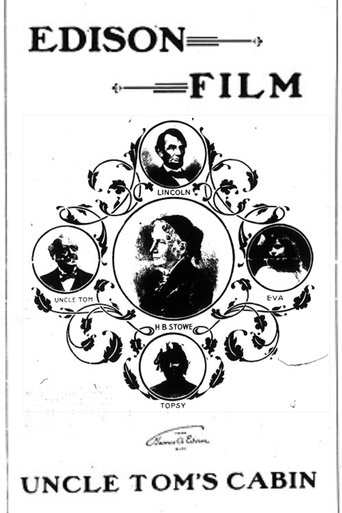
Uncle Tom's Cabin (1903)
Based on the novel by Harriet Beecher Stowe: Eliza, a slave who has a young child, pleads with Tom, another slave, to escape with her. Tom does not leave, but Eliza flees with her child. After getting some help to escape the slave traders who are looking for her, she then must try to cross the icy Ohio River if she wants to be free. Meanwhile, Tom is sold from one master to another, and his fortunes vary widely.
- Date of release
- 1903-09-05
- TMDB
- 4.9 / 10 (34)
- Runtime
- 19m
- Genres
- Drama
- Director
- Edwin S. Porter
Interesting facts
- Based on: Uncle Tom's Cabin
Uncle Tom's Cabin is a 1903 American silent short drama directed by Edwin S. Porter and produced by the Edison Manufacturing Company. The film was adapted from the 1852 novel Uncle Tom's Cabin by Harriet Beecher Stowe. The plot streamlined the actual story to portray the film over the course of 19 minutes. The film was released on 3 August 1903 at the Huber's Fourteenth Street Museum in New-York.
Production and release
Uncle Tom's Cabin was one of the earliest "full-length" American movies, although in 1903 this meant about 19 minutes. Porter shot the film at the Edison Company's studio in New York. Rather than an adaptation of the novel, the movie's actors, sets, costumes and much of its staging derive from one of the turn-of-the-century theatrical Tom Shows which were very popular at the time.
The film premiered on 3 August 1903 at Huber's Fourteenth Street Museum, sharing the program with several live acts, including a pair of "colored comedians".
On 12 September, Sigmund Lubin released a slightly shorter version of Uncle Tom's Cabin which was "remarkably similar" to Porter's version, a practice which was quite common in the early days of cinema when copyright protection of films was not well established.
Read on Wikipedia · Text from Wikipedia, CC BY-SA 4.0. Data from Wikidata.
Recommended
- The Nest 2020 · ★ 6.1
- Most 2003 · ★ 7.3
- Bastard Out of Carolina 1996 · ★ 7.1
- The Kindness of Strangers 2019 · ★ 6.4
- The Effect of Gamma Rays on Man-in-the-Moon Marigolds 1972 · ★ 7.3
- What Maisie Knew 2013 · ★ 7.1
- Salomé 2013 · ★ 6.1
- The Padre 2018 · ★ 5.9
- O.G. 2018 · ★ 5.9
- Holy Lands 2019 · ★ 6.1
- Poor Cow 1967 · ★ 6.4
- Nowhere to Run 1993 · ★ 6.6