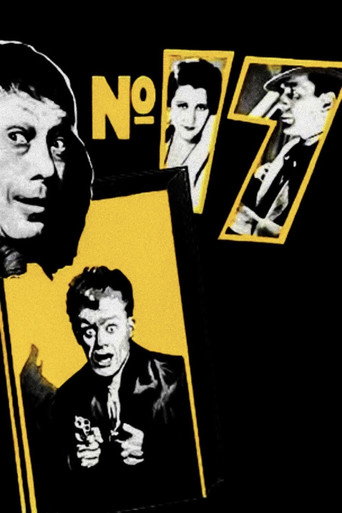
Number Seventeen (1932)
A great play. A great novel. And a greater film.
A gang of jewel thieves hides out in an abandoned London house after a robbery, unaware that a detective is among them in disguise.
- Date of release
- 1932-07-18
- TMDB
- 5.5 / 10 (128)
- Runtime
- 1h 3m
- Genres
- Thriller, Mystery, Crime
- Director
- Alfred Hitchcock
Casting
- Leon M. Lion — Ben
- Anne Grey — Nora
- John Stuart — Barton
- Donald Calthrop — Nora's Escort Brant
- Barry Jones — Henry Doyle
- Ann Casson — Rose Ackroyd
- Henry Caine — Mr. Ackroyd
- Garry Marsh — Sheldrake
- Herbert Langley — The Guard on Train (uncredited)
Interesting facts
Number Seventeen is a 1932 British comedy thriller film directed by Alfred Hitchcock and starring John Stuart, Anne Grey and Leon M. Lion. The film, which is based on the 1925 burlesque stage play Number Seventeen written by Joseph Jefferson Farjeon, concerns a group of criminals who commit a jewel robbery and hide their loot in an old house over a railway leading to the English Channel. The film's title is derived from the house's street number.
Production
Hitchcock returned to England from a trip to the Caribbean with a new idea for a film. He told John Maxwell about it, but Maxwell said that Walter C. Mycroft had a different project for Hitchcock: a filmed version of Joseph Farjeon's play Number Seventeen, which had already been filmed. Hitchcock was unhappy with the project, as he considered the story to be riddled with cliches.
Hitchcock was assigned writer Rodney Ackland for the film, which was intended as a comedy-oriented thriller.
Although the opening credits confirm the picture's title as Number Seventeen, much of the promotional material and many modern-day film databases refer to the film as Number 17, which was its American release title. In the 1966 book Hitchcock/Truffaut, Hitchcock called the film a "disaster."
The film makes extensive use of miniature sets, including a model train, bus and ferry.
This is one of the few Hitchcock thrillers that Hitchcock himself doesn't have a cameo in.
Read on Wikipedia · Text from Wikipedia, CC BY-SA 4.0. Data from Wikidata.
Recommended
- The Commuter 2018 · ★ 6.4
- Play Dirty 2025 · ★ 6.6
- Murphy's Law 1986 · ★ 6.1
- Trap House 2025 · ★ 6.6
- The International 2009 · ★ 6.3
- Secret in Their Eyes 2015 · ★ 6.4
- The Black Book 2023 · ★ 6.7
- Den of Thieves 2: Pantera 2025 · ★ 6.6
- Blood Ties 2013 · ★ 6.1
- 12 Rounds 3: Lockdown 2015 · ★ 6.0
- Take Back 2021 · ★ 5.9
- Shade 2003 · ★ 6.2