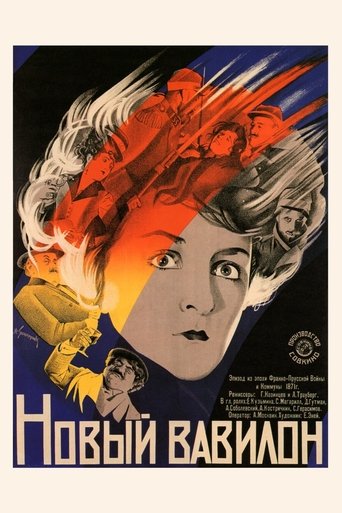
La nueva Babilonia (1929)
Новый Вавилон
En el año de 1870, en pleno auge de la guerra Franco-Prusiana, el desarrollo del conflicto bélico dio lugar a que las tropas de Prusia avanzaran sobre la capital francesa. Ante la inminente invasión de París, el gobierno francés se apresuró a pedir una tregua, lo que pronto dio lugar a la capitulación total. El orgulloso pueblo francés, avergonzado por la pusilánime reacción del gobierno, se alzó enfurecido. El gobierno sustituto, la Comuna, duró menos de dos meses en el poder, y sus líderes fueron prontamente fusilados. Con estos hechos como referencia, los cineastas rusos Grigori Kozintsev y Leonid Trauberg concibieron un filme en el que siguieron un procedimiento bastante común: el narrar un hecho de importancia histórica universal a través de la visión de personajes individuales. En el caso del filme de Kozintsev y Trauberg, el personaje principal es Louise Poirier, dependienta de una la tienda parisina que da su nombre al filme, La Nueva Babilonia.
- Fecha de estreno
- 1929-03-18
- TMDB
- 6.1 / 10 (26)
- Duración
- 1 h 32 min
- Géneros
- Drama, Historia
- Director
- Леонид Трауберг, Григорий Козинцев
Reparto
- Елена Кузьмина — Louise Poirier, the shop-assistant
- Пётр Соболевский — Jean, French soldier
- Давид Гутман — Owner of the 'New Babylon' shop
- Софья Магарилл — An actress
- Андрей Костричкин — The main shop-assistant
- Сергей Герасимов — Lutro, the journalist
- Янина Жеймо — Therese, a seamstress
- Арнольд Арнольд — Commune's Central Committee member
- Борис Азаров — Soldier (uncredited)
- Bernshtein — Friko (uncredited)
- Iraida Vinogradova — (uncredited)
- Эмиль Галь — Bourgeois (uncredited)
Curiosidades
The New Babylon is a 1929 silent historical drama film written and directed by Grigori Kozintsev and Leonid Trauberg. The film deals with the 1871 Paris Commune and the events leading to it, and follows the encounter and tragic fate of two lovers separated by the barricades of the Commune.
Production
The New Babylon was staged with members of the "Factory of the Eccentric Actor" (FEKS), an avant-garde artists' association founded by Kozintsev and Trauberg in 1922 that sought to create new paths in the performing arts. FEKS first began as a theater group, but in the following years, many of its members shaped the Russian-Soviet film history when working as actors, outfitters, and cinematographers.
FEKS were influenced by street art and their cinematic preference was D. W. Griffith and Chaplin, not German expressionistic cinema of the early 1920s. "Yesterday: salons, obeisances, barons. Today: yells of newsboys, scandals, policeman's truncheon, noise, scream, stomping, running," declared Kosintsev and Trauberg in their Manifesto of the Eccentric Actor.
Like Kosintsev and Trauberg, twenty-two year old Dmitri Shostakovich was a member of the film group of "FEKS", dedicated to the abolition of the borders between theater, film, circus, music hall and opera. In his musical score he used various musical forms: dance and operetta melodies as well as French folk music and revolutionary songs: "Ça ira", "La Carmagnole" and "La Marseillaise"; it served as a leitmotif for the reactionary bourgeoisie and…
The score, which bears the Opus number 18, was lost shortly after the premiere, and was only discovered again shortly after Shostakovitch's death in 1975.
The Russian premiere of The New Babylon took place on 18 March 1929 in Leningrad. It was one of a number of Soviet silent films rejected by the British Board of Film Censors, but was passed with a U certificate in 1982.
Leer en Wikipedia · Texto de Wikipedia, CC BY-SA 4.0. Datos de Wikidata.
Recomendadas
- El fin de San Petersburgo 1927 · ★ 6.7
- Múnich en vísperas de una guerra 2021 · ★ 6.9
- Malditos bastardos 2009 · ★ 8.2
- Radium Girls 2020 · ★ 6.6
- Topaz 1969 · ★ 6.0
- Tsar 2009 · ★ 6.0
- Siberiada 1979 · ★ 7.2
- Sufragistas 2015 · ★ 7.2
- AK-47 2020 · ★ 7.6
- Jacknife 1989 · ★ 6.4
- Panther 1995 · ★ 6.3
- K-19: The Widowmaker 2002 · ★ 6.6