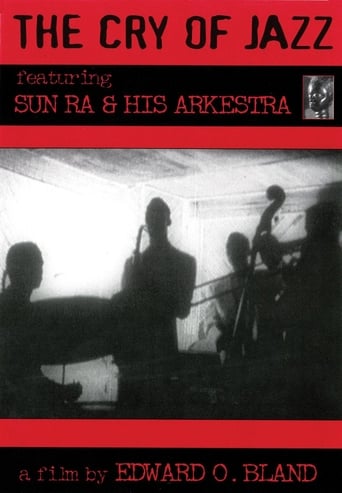
The Cry of Jazz (1959)
Filmed in Chicago & finished in 1959, The Cry of Jazz is filmmaker, composer and arranger Edward O. Bland's polemical essay on the politics of music and race - a forecast of what he called "the death of jazz." A landmark moment in black film, foreseeing the civil unrest of subsequent decades, it also features the only known footage of visionary pianist Sun Ra from his beloved Chicago period. Featured are ample images of tenor saxophonist John Gilmore and the rest of Ra's Arkestra in Windy City nightclubs, all shot in glorious black & white.
- Date of release
- 1959-03-22
- TMDB
- 6.2 / 10 (16)
- Runtime
- 34m
- Genres
- Documentary, Music
- Director
- Edward Bland
Casting
- George Waller — Alex Johnson
- Dorothea Horton — Natalie
- Melinda Dillon — Faye
- Andrew Duncan — John
- Leroy Inman — Louis
- James Miller — Bob
- Gavin McFadyan — Bruce
- Carl Dupree
- Goldina Rojas
- Alan Leavitt
- Carl McCormack
- Lettie Mae Randolph
Interesting facts
The Cry of Jazz is a 1959 documentary film by Edward O. Bland that connects jazz to African American history. It uses footage of Chicago's black neighborhoods, performances by Sun Ra, John Gilmore, and Julian Priester and the music of Sun Ra and Paul Severson interspersed with scenes of musicians and intellectuals, both black and white, conversing at a jazz club. It has been credited as being an early example of the Black pride movement and with predicting the urban riots of the 1960s and 1970s, and has been called the first hip-hop film.
Production
In the early to mid 1950s the composer Edward Bland, novelist Mark Kennedy, city-planner Nelam Hill, and mathematician Eugene Titus conceived the idea for The Cry of Jazz. Together they formed KHTB Productions, which took its name from the first letter of each person's last name. It took several years for them to write the script, and several more to make the film itself.
As the production of The Cry of Jazz began, Bland, serving as the film's Musical Director, was responsible for scoring the film. Bland knew Sun Ra personally, as they were both living in Chicago at the time. Additionally, Bland was aware that Sun Ra owned the rights to his music released through El Saturn Records, his own record label.
Bland wrote the screenplay for a sequel to The Cry of Jazz titled The American Hero, but received 109 rejections from production companies, causing him to abandon the project. Bland gave this description of The American Hero in a 1960 article for the journal Film Culture:
"In our next film, which will be a 35mm feature length film amplifying and carrying further various facets of this film, we expect an even greater impact, primarily because the audience will not be able to use jazz as an escape."
Read on Wikipedia · Text from Wikipedia, CC BY-SA 4.0. Data from Wikidata.
Recommended
- I Called Him Morgan 2016 · ★ 7.0
- Quincy 2018 · ★ 7.3
- The Last Waltz 1978 · ★ 7.7
- Keith Richards: Under the Influence 2015 · ★ 6.8
- Let It Be 1970 · ★ 7.7
- End of the Century: The Story of the Ramones 2003 · ★ 7.6
- Echo in the Canyon 2019 · ★ 6.8
- The Weeknd: Live at SoFi Stadium 2023 · ★ 7.7
- John & Yoko: Above Us Only Sky 2018 · ★ 7.1
- The Wrecking Crew 2008 · ★ 7.4
- David Bowie: The Last Five Years 2017 · ★ 7.1
- Oasis: Don't Look Back in Anger 2026 · ★ 7.0