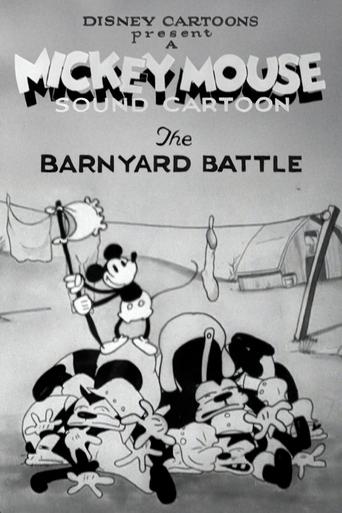
农场战争 (1929)
The Barnyard Battle
当地一缕阳光照进农场,激昂的旋律便响彻农场每一个角落。猫鼠大战爆发在即,老鼠们纷纷应征入伍。米奇也是应征人员中的一个,他接受了粗暴而苛刻的体检,好不容易才通过,于是穿戴好军服扛着枪参加训练。伴随着有力的进行曲,老鼠士兵们精神抖擞。不久,皮特所率领的黑猫部队入侵农场,一场大战在所难免…… 本片是第一部米奇以士兵形象出现的动画作品,片中粗暴体检的桥段在迪斯尼日后的作品里也经常重现。黑猫部队的形象映射了一战期间德军士兵(该片也因此在20世纪20~30年代的德国遭到禁映)。此外,两首曲子《Dixie》和《Battle Cry of Freedom》均为南北战争时的流行曲目。
趣闻
The Barnyard Battle is a 1929 American animated short film directed by Ub Iwerks. It is the seventh film of the Mickey Mouse film series. It was the seventh Mickey Mouse short to be produced, the fourth of that year. As the title implies, it features a battle between an invading army of cats and an army of mice trying to defend their homes and farms. It was released on June 1, 1929 by Celebrity Productions. Columbia Pictures reissued the film after Walt Disney Productions switched distributors. The short is in the public domain.
Production
This short is notable as the first to depict Mickey as a soldier and the first to place him in combat. The physical examination scene has since often been edited out, as being somewhat disturbing, but modern viewers have often pointed to this scene as being the most memorable of the short.
There was a precedent in Disney's cartoons for patriotically sending the main character to war for the United States: Julius the Cat calls an army together in the 1926 Alice Comedies short Alice's Little Parade, and Oswald the Lucky Rabbit goes to war in the 1927 cartoon Great Guns!
The mouse officer shouting "Company, forward march!" is the first mammal character in the Mickey Mouse cartoons to speak a full sentence. Before this, characters have only communicated in single-syllable sounds and laughs, or in the case of Minnie Mouse, the greeting, "Yoo-Hoo!" The parrot in Steamboat Willie also spoke two full sentences, making him the actual first character in the series to speak this way.
This is the last Mickey Mouse cartoon in which Mickey is shown as mouse-sized among a crowd of other mice; after this, Mickey and Minnie became the only mice living in a world of other anthropomorphized animals.
The short did not clearly identify the war it depicted, but it has been noted that the cats are depicted as wearing military helmets similar to those used by the German Empire during World War I. On the other hand, the mice are marching in battle to the tune of "Dixie", a song written in 1859. The song was popular among the forces of the Confederate States of America during the American Civil War.
在维基百科阅读更多 · 文本来自维基百科,CC BY-SA 4.0。数据来自 Wikidata。
推荐
- 米老鼠:疯狂的飞机 1929 · ★ 6.4
- Mickey's Steam Roller 1934 · ★ 6.4
- 甜蜜的家 1940 · ★ 7.0
- DC展台:洛克中士 2019 · ★ 6.5
- 战争结束了!受列侬和洋子音乐的启发 2023 · ★ 6.2
- 花栗鼠和大坚果 1949 · ★ 6.8
- 纳粹狼的闪电战 1942 · ★ 6.8
- 汽船威利 1928 · ★ 7.3
- 聪明的小母鸡 1934 · ★ 6.6
- Playful Pluto 1934 · ★ 6.3
- 米奇妙世界之米奇笑笑一百年 2023 · ★ 6.9
- 米老鼠和海豹 1948 · ★ 6.8