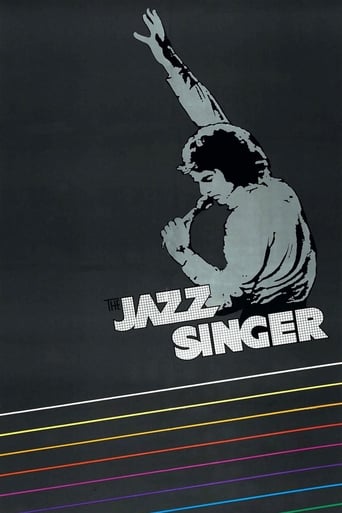
The Jazz Singer (1980)
His story will make you cry. His music will make you sing. His triumph will make you cheer.
A young Jewish man is torn between tradition and individuality when his old-fashioned family objects to his career as a jazz singer.
- Date of release
- 1980-12-17
- TMDB
- 5.9 / 10 (77)
- Runtime
- 1h 55m
- Genres
- Drama, Music, Romance
- Director
- Richard Fleischer
Casting
- Neil Diamond — Jess Robin / Yussel Rabinovitch
- Laurence Olivier — Cantor Rabinovitch
- Lucie Arnaz — Molly Bell
- Catlin Adams — Rivka Rabinovitch
- Franklyn Ajaye — Bubba
- Paul Nicholas — Keith Lennox
- Sully Boyar — Eddie Gibbs
- Mike Kellin — Leo
- James Booth — Paul Rossini
- Luther Waters — Teddy
- Oren Waters — Mel
- Rod Gist — Timmy
Interesting facts
- Based on: The Jazz Singer
- Awards: 2 · Nominations: 5. Including: Golden Raspberry Award for Worst Actor; Golden Raspberry Award for Worst Supporting Actor
The Jazz Singer is a 1980 American musical drama film directed by Richard Fleischer and produced by Jerry Leider. The film stars Neil Diamond, Laurence Olivier and Lucie Arnaz, and tells the story of Yussel Rabinovitch, a young singer who is torn between tradition and pursuing his dreams as a pop singer. Based on the 1925 play of the same title by Samson Raphaelson, it is the fourth film adaptation, following the 1927 and the 1952 theatrical adaptions, and a 1959 television adaptation.
Production
The idea for another adaptation of The Jazz Singer came from producer Jerry Leider, who saw Neil Diamond on a 1977 television special Love at the Greek. Leider believed that Diamond could have the same crossover appeal as fellow singers Elvis Presley and Barbra Streisand, the latter of whom had recently starred in the successful remake of A Star Is Born. Encouraged by the success of A Star Is Born, Leider decided to remake The Jazz Singer.
In the fall of 1977, Metro-Goldwyn-Mayer put the remake in development, with principal photography planned to begin in the fall of 1978. Jerry Kass wrote a treatment and Stephen Foreman did the first draft. However, in September 1978, the studio dropped the remake, over "executives being anxious about the movie being 'too Jewish'", according to writer Stephen H. Foreman. The project was picked up by EMI Films and Paramount as a partnership.
Sidney J. Furie signed on to direct in December 1978. He said “I loved the Neil Diamond idea when they pitched it to me. I also felt a personal connection to the material, because of my own background, and because I had had a lot of fun doing Lady Sings the Blues with Diana, who was also a novice." Furie requested Foreman do extensive rewrites. When Foreman left to work on another project, Herbert Baker was brought on to work on the script.
In early 1979, Diamond underwent back surgery, and invoked a clause in his contract that allowed him to finish the original music before filming began. During this time, the studio and Leider did consider replacing Diamond with Barry Manilow, though ultimately decided against it. Meanwhile, Jacqueline Bisset was approached for the lead female role Molly Bell, but asked for too much money.
In July 1979 Barry Spikings of EMI announced that the film was on his studio's slate for the year which would also include The Awakening, The Story of Maria Callas, Discoland (later retitled Can't Stop the Music), and Honky Tonk Freeway. It was part of a deliberate decision by EMI to make more consciously American films. However unlike in previous years, EMI would use a British distributor, Associated Film Distribution.
Read on Wikipedia · Text from Wikipedia, CC BY-SA 4.0. Data from Wikidata.
Recommended
- I Can Only Imagine 2 2026 · ★ 8.1
- Yentl 1983 · ★ 6.7
- Raise Your Voice 2004 · ★ 6.6
- Pure Country 2: The Gift 2010 · ★ 6.7
- The Glenn Miller Story 1954 · ★ 7.0
- Ruth & Boaz 2025 · ★ 7.3
- Michael 2026 · ★ 8.6
- Save the Last Dance 2001 · ★ 6.6
- Footloose 2011 · ★ 6.6
- New York, New York 1977 · ★ 6.5
- August Rush 2007 · ★ 7.4
- Center Stage: Turn It Up 2008 · ★ 6.8