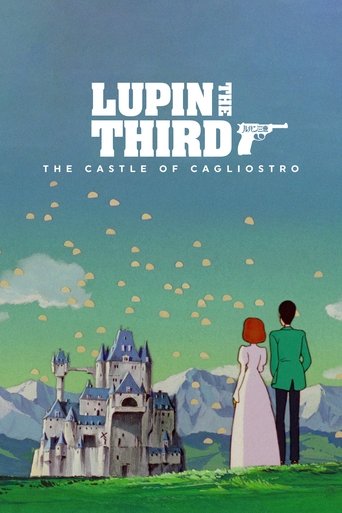
The Castle of Cagliostro (1979)
ルパン三世 カリオストロの城
Believe in the Thief.
After a successful robbery leaves famed thief Lupin the Third and his partner Jigen with nothing but a large amount of expertly crafted counterfeit bills, he decides to track down the forgers responsible—and steal any other treasures he may find in the Castle of Cagliostro, including the 'damsel in distress' he finds imprisoned there.
- Date of release
- 1979-07-06
- TMDB
- 7.5 / 10 (1199)
- Runtime
- 1h 42m
- Genres
- Animation, Adventure, Comedy, Crime
- Director
- Hayao Miyazaki
- Collection
- Lupin the Third Collection
Casting
- Yasuo Yamada — Arsène Lupin III (voice)
- Kiyoshi Kobayashi — Daisuke Jigen (voice)
- Eiko Masuyama — Fujiko Mine (voice)
- Makio Inoue — Goemon Ishikawa XIII (voice)
- Gorō Naya — Inspector Koichi Zenigata (voice)
- Sumi Shimamoto — Lady Clarisse de Cagliostro (voice)
- Taro Ishida — Count Cagliostro (voice)
- Kohei Miyauchi — Gardener (voice)
- Ichiro Nagai — Jodo (voice)
- Tadamichi Tsuneizumi — Gustav (voice)
- Kinpei Azusa — Archbishop (voice)
- Eken Mine — Archbishop's Driver (voice)
Interesting facts
- Box office: $3.8M
- Budget: $2.3M
- Earned 1.6× its budget
- Based on: Lupin III
Lupin III: The Castle of Cagliostro is a 1979 Japanese animated action adventure comedy film directed and co-written by Hayao Miyazaki. It is the second animated feature film based on the 1967–69 manga series Lupin III by Monkey Punch and the third film from said franchise in general. The film was Miyazaki's feature directorial debut after having previously worked as an animator for Toei Animation and Telecom Animation Film, and directing several animated television series, including Lupin III Part I.
Production
Lupin III began as a Japanese manga series written and illustrated by Monkey Punch. The title character, Lupin III, was inspired by (and is claimed in the series to be the grandson of) Maurice Leblanc's fictional character Arsène Lupin, a gallant and famous outlaw able to outsmart even Sherlock Holmes.
Castle of Cagliostro marked Miyazaki's debut as a theatrical movie director, but he also was a writer, a designer, and a storyboardist on the movie.
The production for the film began in May 1979 with the writing of the story and storyboarding for the film. Miyazaki began by drawing a bird's eye view of the setting before creating the story to completion. After the first draft scenario was returned to Miyazaki without change, he began the storyboards.
The film draws upon many sources of inspiration that were important in the production of the film. McCarthy writes that a research trip was not specifically undertaken for the film, but says Miyazaki's Heidi, Girl of the Alps sketchbooks were useful for the scenery. Miyazaki would cite Italian Mountain Cities and the Tiber Estuary from Kagoshima Publishing as influencing the production of the film.
McCarthy describes the summery color palette of the film as matching the scenery and the characters, but notes the use of dark and light colours to emphasize the subplot of the dark and light sides of the Cagliostros. The film's score was composed by series regular Yuji Ohno, and varies between jazz, romance and orchestral music. Notably, it includes a variation of Lupin III's iconic TV theme.
Read on Wikipedia · Text from Wikipedia, CC BY-SA 4.0. Data from Wikidata.
Recommended
- Lupin the Third: The Pursuit of Harimao's Treasure 1995 · ★ 6.4
- Lupin III: The First 2019 · ★ 7.3
- Lupin the Third: Dragon of Doom 1994 · ★ 6.5
- Lupin the Third: The Secret of Twilight Gemini 1996 · ★ 6.4
- One Piece Film: GOLD 2016 · ★ 7.2
- Lupin the Third: Greatest Capers 1995 · ★ 6.6
- Lupin the Third: Bye Bye, Lady Liberty 1989 · ★ 6.4
- One Piece: The Movie 2000 · ★ 7.0
- Case Closed: The Fist of Blue Sapphire 2019 · ★ 6.2
- Lupin the Third vs. Detective Conan 2009 · ★ 6.9
- Pokémon Ranger and the Temple of the Sea 2006 · ★ 6.5
- One Piece Episode of Nami: Tears of a Navigator and the Bonds of Friends 2012 · ★ 7.0