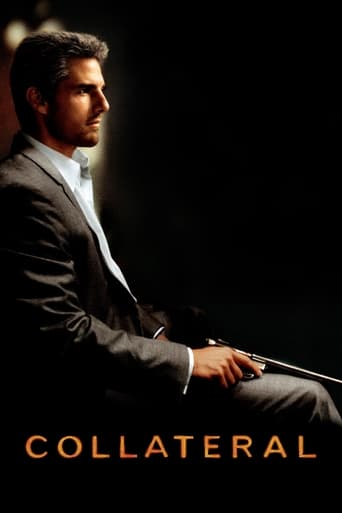
Collateral (2004)
It started like any other night.
Cab driver Max picks up a man who offers him $600 to drive him around. But the promise of easy money sours when Max realizes his fare is an assassin.
- Date of release
- 2004-08-04
- TMDB
- 7.3 / 10 (6666)
- Runtime
- 2h 0m
- Genres
- Drama, Crime, Thriller
- Director
- Michael Mann
Casting
- Tom Cruise — Vincent
- Jamie Foxx — Max Durocher
- Jada Pinkett Smith — Annie Farrell
- Mark Ruffalo — Det. Ray Fanning
- Peter Berg — Richard Weidner
- Javier Bardem — Felix Reyes-Torrena
- Bruce McGill — Frank Pedrosa
- Klea Scott — Zee
- Barry Shabaka Henley — Daniel Baker
- Irma P. Hall — Ida Durocher
- Richard T. Jones — Traffic Cop #1
- Jamie McBride — Traffic Cop #2
Interesting facts
- Box office: $217.8M
- Budget: $65M
- Earned 3.4× its budget
- Filmed in: Long Beach
- Awards: 8 · Nominations: 33. Including: National Society of Film Critics Award for Best Actor; Washington D.C. Area Film Critics Association Award for Best Supporting Actor; National Board of Review Award for Best Director; BET Award for Best Actor & Actress
Collateral is a 2004 American action thriller film directed and produced by Michael Mann, written by Stuart Beattie, and starring Tom Cruise and Jamie Foxx. The supporting cast includes Jada Pinkett Smith, Mark Ruffalo, Peter Berg, Javier Bardem, and Bruce McGill. The film follows Max Durocher (Foxx), a Los Angeles cab driver, and his customer, Vincent (Cruise). When offered a high fare for driving to several locations, Max agrees but soon finds himself taken hostage by Vincent who turns out to be a sociopathic hitman on a contract killing spree.
Production
When he was 17 years old, Australian writer Stuart Beattie took a cab home from Sydney Airport and had the idea of a homicidal maniac sitting in the back of a cab with the driver nonchalantly conversing with him, trusting his passenger implicitly. Beattie drafted his idea into a two-page treatment titled "The Last Domino", then later began writing the screenplay.
Beattie was waiting tables when he came in to contact with Julie Richardson, whom he had met on a UCLA Screenwriting Extension course. Richardson had become a producer and was searching for projects for Frank Darabont, Rob Fried and Chuck Russell's company, Edge City, which was created to make low budget genre films for HBO. Beattie later pitched her his idea of "The Last Domino".
At a general meeting at DreamWorks with executive Marc Haimes, Beattie mentioned the script. Haimes immediately contacted Richardson, read the script overnight, and DreamWorks put in an offer the following day. Early drafts of Collateral's script set the film in New York City. Later revisions of the script moved the film's setting to Los Angeles. Darabont, Fried and Russell would remain on as executive producers.
Mimi Leder and cinematographer Janusz Kamiński were attached to the project at one point as the director. Brazilian filmmaker Fernando Meirelles had initially agreed to direct, but eventually decided to exit as the production would require him to relocate to Los Angeles for eight months. Meirelles described his vision for the film as being that of a comedy, and looked at telling it in a way similar to Martin Scorsese's After Hours.
Upon Russell Crowe expressing interest in playing the role of Vincent, development on the film moved forward. Crowe got his The Insider director Michael Mann involved, but after constant delays, Crowe departed the project. Mann explained that the confined time frame and smaller scale of the film in comparison to previous efforts like The Last of the Mohicans and Heat were what drew him to the project.
Read on Wikipedia · Text from Wikipedia, CC BY-SA 4.0. Data from Wikidata.
Recommended
- The Bone Collector 1999 · ★ 6.8
- Drive 2011 · ★ 7.6
- One Night in Bangkok 2020 · ★ 6.6
- The Last Stop in Yuma County 2024 · ★ 6.9
- Jackie Brown 1997 · ★ 7.4
- The Grissom Gang 1971 · ★ 6.7
- The Usual Suspects 1995 · ★ 8.2
- Heat 1995 · ★ 7.9
- The Hit 1984 · ★ 6.5
- Gangster Squad 2013 · ★ 6.4
- Sexy Beast 2001 · ★ 7.0
- The Getaway 1972 · ★ 7.2