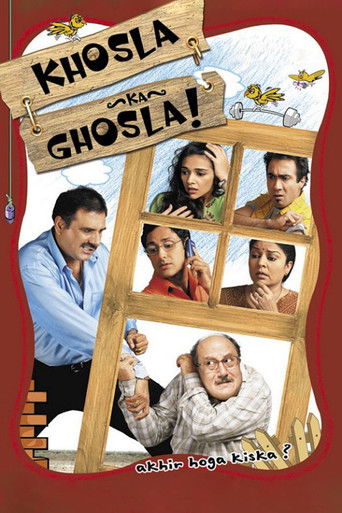
Khosla Ka Ghosla! (2006)
खोसला का घोसला
Aap Party Hai Ya Broker?
Kamal Khosla's (Anupam Kher) peaceful retirement plan doesn't go as planned when his land is grabbed by a land shark, Khurana (Boman Irani). In a bid to retrieve their land, the dysfunctional family hatches a clever plan to con Khurana with the help of their friends.
- Date of release
- 2006-09-22
- TMDB
- 7.4 / 10 (129)
- Runtime
- 2h 15m
- Genres
- Comedy
- Director
- Dibakar Banerjee
Casting
- Anupam Kher — Kamal Kishore Khosla
- Boman Irani — Kishan Khurana
- Parvin Dabas — Chiraunjilal 'Cherry' Khosla
- Ranvir Shorey — Balwant 'Bunty' Khosla
- Tara Sharma — Meghna
- Vinay Pathak — Asif Iqbal
- Navin Nischol — Bapu / M. L. Sethi
- Nitesh Pandey — Mani
- Kiran Juneja — Mrs. Sudha Khosla
- Roopam Bajwa — Nikki Khosla
- Vinod Nagpal — Amar Sawhney
- Rajendra Sethi — Vijayender
Interesting facts
Khosla Ka Ghosla is a 2006 Indian Hindi-language comedy drama film directed by Dibakar Banerjee, in his directorial debut. It was produced by Savita Raj Hiremath under the Taandav Films label and Ronnie Screwvala from UTV Motion Pictures. Written by Jaideep Sahni, the film stars Parvin Dabas, Tara Sharma, Anupam Kher and Boman Irani in the lead roles. The story follows Kamal Kishore Khosla (Kher), a middle-class Delhiite and his family's attempt to reclaim their land which has been seized by a builder, Khurana (Irani).
Production
Dibakar Banerjee, who was making advertisement films in Delhi, wished to make a feature film "which portrayed Delhi as it is". The initial idea of the generation gap was conceived by Savita Raj Hiremath and her writer friend Jaideep Sahni, who had worked with Banerjee on advertising films. Sahni said the soul of Khosla Ka Ghosla was derived from their experience of growing up in a middle-class house in Delhi.
Vinay Pathak had auditioned for Khurana's character for which Boman Irani was eventually selected, but the team liked Pathak's audition and offered him the role of Asif Iqbal. Ranvir Shorey was selected for the role of Balwant after two or three rounds of auditions. The role of Khurana was also offered to Rishi Kapoor who refused it.
During the course of filming, Banerjee kept Irani separate from the rest of the cast as he did not want them to meet. During filming, the investors demanded the addition of action sequences, an item song and changes in the cast. The team did not fancy these changes so Padmalaya Telefilms, their first investor, backed out of the project. Hiremath said that she had to "shell out cash" from her other company.
The entire opening dream sequence was filmed in one take using a hand-held camera to give it a "separate look from the rest of the film". Amitabha Singh served as the director of photography, while Sejal Painter was the editor. Banerjee had a different, sad ending for the film, but opted for Sahni's version of a more optimistic ending after realising his idea would make the film darker. The film did not have any buyers for two years.
Read on Wikipedia · Text from Wikipedia, CC BY-SA 4.0. Data from Wikidata.
Recommended
- Darlings 2022 · ★ 7.0
- Louis C.K.: Ridiculous 2026 · ★ 6.1
- 29th Street 1991 · ★ 6.9
- Lootcase 2020 · ★ 6.5
- Eddie Murphy Raw 1987 · ★ 7.2
- Baadshah 1999 · ★ 6.5
- Phir Hera Pheri 2006 · ★ 6.9
- Babes 2024 · ★ 6.0
- Easy Money 1983 · ★ 6.0
- Merry Christmas, Drake & Josh 2008 · ★ 7.3
- Louis C.K.: Oh My God 2013 · ★ 7.6
- Jim Jefferies: Freedumb 2016 · ★ 7.2