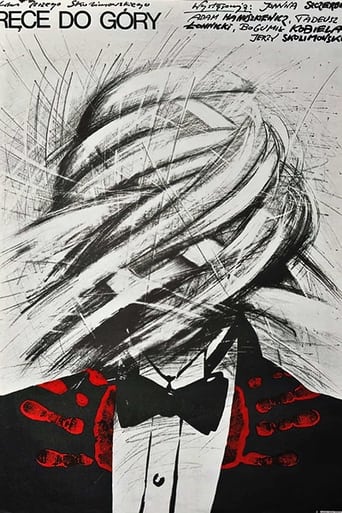
手を挙げろ! (1985)
Ręce do góry
スコリモフスキ自身が主人公の青年を演じるアンジェイ3部作の最終章。医師になったアンジェイが、列車の中で共産主義について考察する様子を描く。
- 公開日
- 1985-01-21
- TMDB
- 5.8 / 10 (14)
- 上映時間(分)
- 1時間23分
- ジャンル
- ドラマ
- 監督
- イエジー・スコリモフスキ
キャスト
- イエジー・スコリモフスキ — Andrzej Leszczyc, Zastawa (1967 footage) / Self (1981 footage)
- Joanna Szczerbic — Alfa (1967 footage)
- タデウシュ・ウォムニツキ — Opel Record (1967 footage)
- Adam Hanuszkiewicz — Romeo (1967 footage)
- Bogumił Kobiela — Wartburg (1967 footage)
- アラン・ベイツ — Self (1981 footage)
- Jane Asher — Self (1981 footage)
- David Essex — Self (1981 footage)
- ブルーノ・ガンツ — Self (1981 footage)
- Karol Kulik — Self (1981 footage)
- Michael Sarne — Self (1981 footage)
- Gerald Scarfe — Self (1981 footage)
豆知識
Hands Up! is a Polish drama film directed by Jerzy Skolimowski. It is the third of a series of semi-autobiographical films in which Skolimowski himself plays his alter ego Andrzej Leszczyc. Originally filmed in 1967, Hands Up! was banned at the time in communist Poland because it critiqued Nazism in Poland, the Stalinist past in post-World War II Poland, and the socio-political climate in sixties Poland. The communist authorities not only banned the film, but also effectively sent Skolimowski into a lengthy exile.
Production
Hands Up! was originally made in 1967 in monochrome by Zespól Filmowy Syrena (pl) studio. Skolimowski said about the film in 1968 for Sight and Sound, "It is a provocation about political and social problems in Poland: a black film, not very explicit, with lots of allusions. The story line is realistic and non-realistic at the same time, but difficult to talk about.
Witold Sobociński's cinematography for the 1967 film, his first, has been noted for creating a rhythmic sense of mood and light, especially in the transformational space of the dark freight train.
The 1967 film was withdrawn from the Venice Film Festival. During the briefly liberalised climate of Poland's Solidarity movement, Skolimowski was invited to update Hands Up! and "re-release the film" in 1981, prompting Skolimowski to seize upon the abrupt relaxation of censorship.
In a 25-minute section (filmed in colour) added by Skolimowski in 1981, he explains how the original was withheld by Polish censors of the time and that this was a principal cause of his leaving his country; however following liberalisation in Poland, he was invited to resuscitate it.
The 80-minute 1981 release of Hands Up! that screened at Cannes was shelved by Polish censors. When the film was finally screened in Poland in 1985, it was edited down to 76 minutes.
Wikipediaで続きを読む · テキストはWikipedia、CC BY-SA 4.0。データはWikidata。
おすすめ
- O-Bi, O-Ba: The End of Civilization 1985 · ★ 6.9
- マン・ダウン 戦士の約束 2016 · ★ 6.0
- スワン・ソング 2021 · ★ 7.1
- Sleep Dealer 2008 · ★ 5.9
- リベリオン~ワルシャワ大攻防戦~ 2014 · ★ 6.7
- 陽だまりのグラウンド 2001 · ★ 6.5
- Bastard Out of Carolina 1996 · ★ 7.1
- 戦場のピアニスト 2002 · ★ 8.4
- 性本能と原爆戦 1962 · ★ 6.3
- Bennett's War 2019 · ★ 6.7
- Right at Your Door 2006 · ★ 5.8
- 偶然 1987 · ★ 7.5