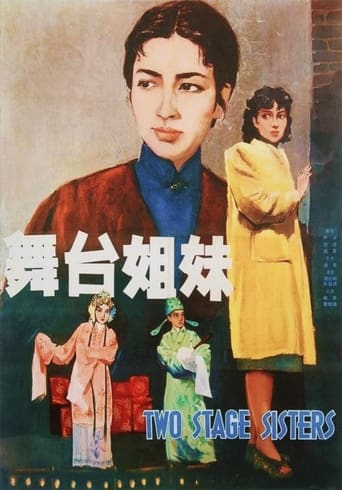
Two Stage Sisters (1964)
舞台姐妹
In pre-revolutionary China, two young girls, Chunhua and Yuehong Xing, rise through the ranks of Chinese opera, but with their artistic success comes a new series of personal and social challenges.
Casting
- Xie Fang — Zhu Chunhua
- Cao Yindi — Xing Yuehong
- Li Wei — Manager Tang
- Shangguan Yunzhu — Shang Shuihua
- Deng Nan — A Xin
- Xu Caigen — Jin Shui
- Qi Feng — Xing Shi Fu
- Han Tao — Judge
- Ding Ran — Official Pan
- Mao Lu
- Ma Ji — Qian Dakui
- Hao Shen — Shen's Mama
Interesting facts
Two Stage Sisters is a 1964 Chinese drama film produced by Shanghai Tianma Film Studio and directed by Xie Jin, starring Xie Fang and Cao Yindi. Made just before the Cultural Revolution, it tells the story of two female Yue opera practitioners from the same troupe who end up taking very different paths in their lives: "one succumbs to bourgeois affluence and privilege, while the other finds inspiration and fulfilment in the social commitment associated with the May Fourth movement and the thought of Lu Xun." The film documents their journey through abusive feudal conditions in the countryside before achieving success and prestige on the stage, meanwhile historically following Shanghai's expe…
Background and cultural contexts
Xia Yan, Vice Minister of Culture when the film was made, had made script corrections and encouraged Xie Jin to shoot the film. Xia Yan was particularly disliked by Mao's wife, Jiang Qing, and thus Two Stage Sisters is argued to have stood out for censure due to its association with Yan.
The film was caught in the escalating ideological purges leading up to the Cultural Revolution. Jiang Qing, Mao Zedong's wife and a key architect of the Cultural Revolution, personally labeled *Two Stage Sisters* a "poisonous weed" (毒草). It was aggressively attacked by radical leftists and banned from public screens for fifteen years.
The primary ideological denunciation against the film was that it "advocated the reconciliation of social classes" (阶级调和论) rather than reflecting absolute class struggle. Critics argued that the film softened class conflict by portraying certain antagonistic or bourgeois characters with human complexity, which violated the rigid codes of socialist realism.
The narrative tracking of the protagonists' encounter with left-wing journalism mirrors the historical alignment of urban cultural workers with the Communist underground in 1940s Shanghai. In Xie's depiction, the communist state becomes the inheritor of the leftist realist tradition, but Xie Jin knew the reality was otherwise.
Two Stage Sisters demonstrates director Xie's keen interest in traditional Chinese opera art, which he had studied during the Japanese Occupation at the Jiangen Drama Academy. He had then worked with well-known opera practitioners such as Huang Zuoling and Zhang Junxiang.
Read on Wikipedia · Text from Wikipedia, CC BY-SA 4.0. Data from Wikidata.
Recommended
- Buddha Mountain 2011 · ★ 6.7
- Skin 2009 · ★ 6.4
- Fast Girls 2012 · ★ 6.0
- Gracie 2007 · ★ 6.2
- El Chicano 2019 · ★ 6.6
- The Boys from Fengkuei 1983 · ★ 7.2
- Brotherly Love 2015 · ★ 7.0
- Tigertail 2020 · ★ 6.7
- Herself 2020 · ★ 6.7
- Caught by the Tides 2024 · ★ 6.7
- One Second 2020 · ★ 7.3
- What Maisie Knew 2013 · ★ 7.1