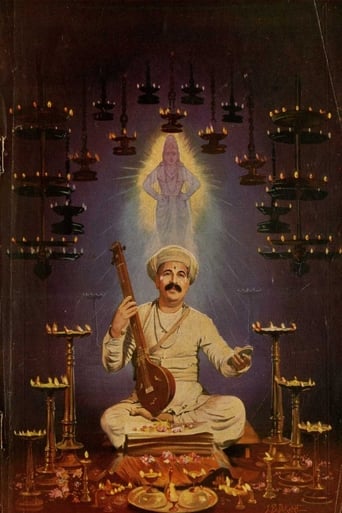
Sant Tukaram (1936)
This classic film chronicles the life of Tukaram (17th C.), one of Maharashtra’s most popular saint poets, activating the 20th century resonances of his turning away from courtly Sanskrit towards vernacular rhythms of religious poetry.
- Date of release
- 1936-03-04
- TMDB
- 7.1 / 10 (12)
- Runtime
- 2h 11m
- Genres
- Drama
- Director
- Vishnupant Govind Damle, Sheikh Fattelal
Casting
- Vishnupant Pagnis — Tukaram
- Gauri — Jijai
- B. Nandrekar
- Shankar Kulkarni
- Kusum Bhagwat
- Shanta Majumdar
- Master Chhotu
- Pandit Damle
- Kaka Bhagvat
- Sri Bhagwat — Brahmin Salomalo
Interesting facts
Sant Tukaram, also known as Saint Tukaram, is a 1936 Marathi film, produced by Prabhat Film Company and based on the life of Tukaram (1608–50), a prominent Varkari saint and spiritual poet of the Bhakti movement in India. The film was directed by Vishnupant Govind Damle and Sheikh Fattelal and featured Vishnupant Pagnis in the lead role of the saint.
Production
Sant Tukaram was directed by Vishnupant Govind Damle and Sheikh Fattelal. The script was written by Shivram Washikar. It was produced at the Prabhat Film Company at Pune owned by V. Shantaram, a notable and internationally acclaimed film maker of India. The film was made in Marathi language. The running time is 131 minutes.
Two earlier films from 1932 tried to capture Tukaram's life, but were unsuccessful at the box office. While those focussed on the miracles of the saint, directors Damle and Fattelal tell the story of a saint who rose from the common folk, concentrating on his everyday life, with little importance given to miracles.
Damle and Fattelal created the settings to ensure that the features of the actors were accentuated distinctly in the film by having minimum background settings and scenes, which was termed as "compositional style”. The film was made in neo-realistic style (a style which came into vogue much later in foreign films) and provided telling performances from all the artists but the most impressive, which won the hearts of the people, was that of Jijai,…
The filming is done in traditional style. After the title cards are presented, a song dedicated to Vithoba, seen as a black stone image, is presented. The song which begins with the title cards is also continued. The meditative shot of Tukaram gives a Bhakti ethos which is continued for about 2 minutes.
Read on Wikipedia · Text from Wikipedia, CC BY-SA 4.0. Data from Wikidata.
Recommended
- Skin 2009 · ★ 6.4
- Paterson 2016 · ★ 7.1
- Skater Girl 2021 · ★ 7.2
- For Colored Girls 2010 · ★ 6.7
- The Girl in the Book 2015 · ★ 5.8
- I'm Thinking of Ending Things 2020 · ★ 6.5
- Eleanor the Great 2025 · ★ 6.8
- Richard Jewell 2019 · ★ 7.4
- I Believe in Unicorns 2015 · ★ 6.7
- Court 2015 · ★ 7.0
- Here 2024 · ★ 6.5
- Effie Gray 2014 · ★ 6.0