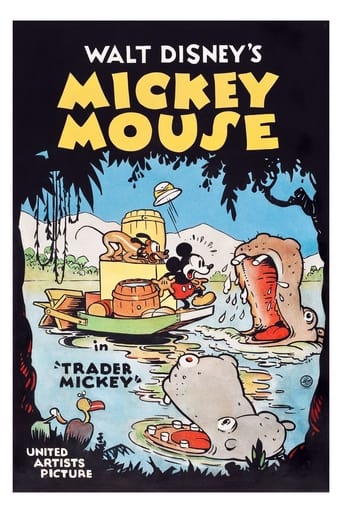
Trader Mickey (1932)
Mickey Mouse and Pluto are traveling up an African river with a cargo of goods (including several musical instruments). They hit land and are captured by cannibals who plan to eat them. As soon as Mickey starts playing on a saxophone, they all start jamming to "The Darktown Strutter's Ball."
- Date of release
- 1932-08-19
- TMDB
- 6.0 / 10 (30)
- Runtime
- 8m
- Genres
- Animation, Comedy
- Director
- David Hand
Casting
- Walt Disney — Mickey Mouse (voice) (uncredited)
- Pinto Colvig — Cannibal Chief (voice) (uncredited)
Interesting facts
Mickey Mouse is a series of American animated comedy short films produced by Walt Disney Productions. The series started in 1928 with Steamboat Willie with 2013's Get a Horse! being the most recent short in the series to date, otherwise taking a hiatus from 1953 to 1983. The series is notable for its innovation with sound synchronization and character animation, and also introduced well-known characters such as the titular protagonist Mickey Mouse, Minnie Mouse, Pluto and Goofy.
Production
Disney began secretly producing the first Mickey Mouse films while still contractually required to finish some Oswald the Lucky Rabbit cartoons for producer Charles Mintz. The first two films, Plane Crazy and The Gallopin' Gaucho, were previewed in theaters but failed to pick up a distributor for a broad release. For the third film, Disney added synchronized sound, a technology that was still in its early stages at the time.
Production slowed towards the end of the 1930s as the studio began to focus on other characters and feature-length films. The series was informally retired in 1953 with the release of The Simple Things, but was revived in 1983 and 1990 with two featurettes, or three reel short films.
The cartoons were directed by 20 different people. Those with the most credits include Burt Gillett (34), Wilfred Jackson (18), Walt Disney (16), David Hand (15), and Ben Sharpsteen (14); the director of the most recent installment, Lauren MacMullan, was the first female director. Notable animators who worked on the series include Ub Iwerks, Norm Ferguson, Ollie Johnston, Frank Thomas, and Fred Moore.
Read on Wikipedia · Text from Wikipedia, CC BY-SA 4.0. Data from Wikidata.
Recommended
- Canine Caddy 1941 · ★ 6.5
- Solid Serenade 1946 · ★ 7.5
- Good Scouts 1938 · ★ 6.3
- The Bodyguard 1944 · ★ 7.4
- His Mouse Friday 1951 · ★ 6.5
- Mickey's Delayed Date 1947 · ★ 6.6
- A Knight for a Day 1946 · ★ 6.6
- The Yankee Doodle Mouse 1943 · ★ 7.2
- Sea Scouts 1939 · ★ 6.4
- Donald's Nephews 1938 · ★ 6.5
- Building a Building 1933 · ★ 6.7
- Barbecue Brawl 1956 · ★ 6.7