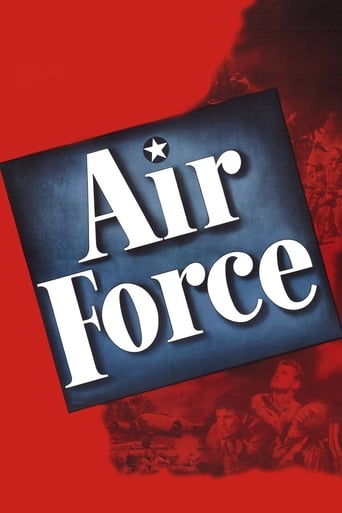
空中堡垒 (1943)
Air Force
苍穹巨人……破空前行,直指胜利!
好莱坞在二次世界大战期间拍摄的最佳抗战宣传片之一。导演霍华德真实地拍摄了美国空军B-17轰炸机 “玛丽安”号及有关的轰炸药小组成员的故事,全片的“政治意识”十分鲜明,但并不影响故事的推展。编剧达德利撰写的对白精简有力,不少场面的安排反映出他对空军的敬意,战斗动作场面高精尖紧凑刺激。
演员阵容
- John Ridgely — Pilot
- 吉格·杨 — Co-Pilot
- John Garfield — Tail Gunner Joe Winocki
- 阿瑟·肯尼迪 — Bombardier
- George Tobias — Asst. Crew Chief
- Charles Drake — Navigator
- 亨利·凯里 — Crew Chief
- Ward Wood — Radio Operator Peterson
- Ray Montgomery — Asst. Radio Operator Chester
- James Brown — Pilot Tex Rader
- 斯坦利·里奇斯 — Maj. Mallory - Clark Field
- 威拉德·罗伯逊 — Colonel at Hickam Field
趣闻
- 拍摄地:坦帕和兰多夫空军基地
- 获奖:2 · 提名:4. 包括:奥斯卡最佳影片剪辑奖; 國家評論協會獎:十大佳片
Air Force is a 1943 American World War II aviation film directed by Howard Hawks and starring John Garfield, John Ridgely, Gig Young, Arthur Kennedy, and Harry Carey. The film was distributed by Warner Bros. Pictures and produced by Hal B. Wallis and Jack L. Warner. It contains incidents of supposed fifth-column activities by Japanese Americans that never happened. Conceived by then-Lieutenant General “Hap” Arnold in the aftermath of the Pearl Harbor attack, it was originally scheduled for release on December 7, 1942, on the first anniversary. It became impossible to meet that deadline, and it premiered in New York City on February 3, 1943, and was released on March 20.
Production
Director Howard Hawks credited the concept of the film to Lieutenant General Henry H. Arnold, Commanding General of the Army Air Forces, loosely based on the experiences of an actual flight of twelve B-17s that left Hamilton Field, California, on the night of December 6, 1941, and literally flew into the war the next morning at Pearl Harbor.
Although pre-production work had already been done, the official start of the production on 18 May 1942 was tied to the War Department's approving the script. Development of the film was concurrent with scriptwriting by Dudley Nichols, with some characters based on Air Corps personnel Hawks met while traveling to Washington, D.C., to confer with Arnold and the War Department Motion Picture Board of Review.
Principal photography, consisting of aerial shots and exteriors, took place at Hendricks Army Airfield, Florida. For water scenes and shooting miniatures shots, MacDill Field, Florida; Randolph Field, Texas; and Santa Monica Bay, California, were used. Shooting began 18 June 1942, using a rented mock-up of a B-17 interior, in which the 10 principal characters performed for a month.
At the end of August, Hawks returned to Hollywood and engaged William Faulkner to rewrite two scenes, including the death of the Mary-Ann's pilot. By then, the film, scheduled to be completed by 17 September, was three weeks behind schedule and only half completed. Production featured a celebrated clash between producer Hal Wallis and Hawks over the latter's constant changing of dialogue as scenes were shot.
Wallis wrote that AAF Captains Sam P. Triffy and Hewett T. Wheless were technical advisors to the film, and that Triffy in particular made significant contributions to the storyline, dialogue, and sets. "Shorty" Wheless had previously been a B-17 aircraft commander in the Philippines with the 19th Bomb Group and had been one of the survivors evacuated to Australia in December 1941.
在维基百科阅读更多 · 文本来自维基百科,CC BY-SA 4.0。数据来自 Wikidata。