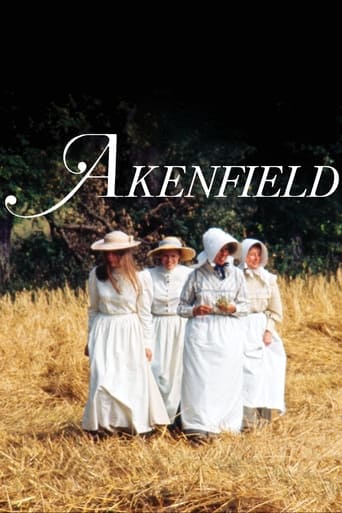
Akenfield (1974)
As a young man, Tom, prepares to leave the Suffolk village of his birth, voices and experiences from his family's past crowd in on his mind, weaving a poetic tapestry of the love of home and the longing to get away from it.
- Date of release
- 1974-11-18
- TMDB
- 7.6 / 10 (7)
- Runtime
- 1h 38m
- Genres
- Drama
- Director
- Peter Hall
Casting
- Stanley Baxter — Blacksmith
- Ronald Blythe — The Vicar
- Ethel Branton — Mrs. Quantrill
- Lyn Brooks — Charlotte Rouse
- Garrow Shand — Tom Rouse
- Peggy Cole — Dulcie Rouse
- Barbara Tilney — Jean Quantrill
- Ida Page — Aunt Ida
- Ted Dedman — Ted
- Mollie Dedman — Mollie
- Charlie Cornish — Charlie
- Charlie Whiting — Charlie
Interesting facts
Akenfield is a 1974 British film directed by Peter Hall in 1974, based loosely upon the book Akenfield: Portrait of an English Village by Ronald Blythe (1969). Blythe has a cameo role as the vicar and all other parts are played by real-life villagers who improvised their own dialogue; there are no professional actors in the piece. Blythe's book is the distillation of interviews with 49 local people, maintaining privacy with false names and sometimes amalgamating two people in one. Blythe once referred to his book as a work of poetry. The film is a work of fiction, based on an 18-page story synopsis by Blythe.
Background
The preliminaries to filming were protracted, and Blythe had many reservations about the difficulties in making a film showing "three generations in terms of work, belief, education and climate. For this is what Akenfield is really concerned with".
'Akenfield' is a made-up placename based partly upon Akenham (a small village just north of Ipswich, the county town of Suffolk) and probably partly on Charsfield, a village just outside the small town of Wickham Market, about ten miles north-east of Akenham. The film of Akenfield was made on location in the villages just west of Wickham Market, notably Hoo, Debach, Charsfield, Monewden, Dallinghoo, Letheringham, Burgh and Pettistree.
The actors in the film were non-professional, drawn from the local population, and therefore speak with authentic accents and play their parts in a manner unaffected by the habit of stage or screen performance. After making the film, most returned to usual rural occupations. Garrod Shand plays all three generations, grandfather, father and son. The voice of old Tom was by Peter Tuddenham.
Ronald Blythe's book Akenfield is a gritty work of hard scholarship, rooted in detailed statistical data, presenting a very realistic grounded understanding of the economic and social life of a village. Life in Blythe's written Akenfield is less anecdotal than, for instance, John Moore's Brensham or Elmbury. The film is a translation of this scholarly view into a portrait of a rural community told through the eyes of one of its members.
Blythe had spent the winter of 1966–7 listening to three generations of his Suffolk neighbours in the villages of Charsfield and Debach, recording their views on education, class, welfare, religion, farming and also death. Published in 1969, the book painted a picture of country living at a time of change – its stories told in the voices of the farmers and villagers themselves.
Read on Wikipedia · Text from Wikipedia, CC BY-SA 4.0. Data from Wikidata.
Recommended
- The Color of Friendship 2000 · ★ 6.7
- The River 1984 · ★ 6.4
- The Bookshop 2017 · ★ 6.5
- Tigertail 2020 · ★ 6.7
- The Effect of Gamma Rays on Man-in-the-Moon Marigolds 1972 · ★ 7.3
- Skin 2009 · ★ 6.4
- The Last Bus 2021 · ★ 6.5
- The Girl in the Book 2015 · ★ 5.8
- A Question of Faith 2017 · ★ 7.5
- Adopt a Highway 2019 · ★ 6.9
- Fast Girls 2012 · ★ 6.0
- Eleanor the Great 2025 · ★ 6.8