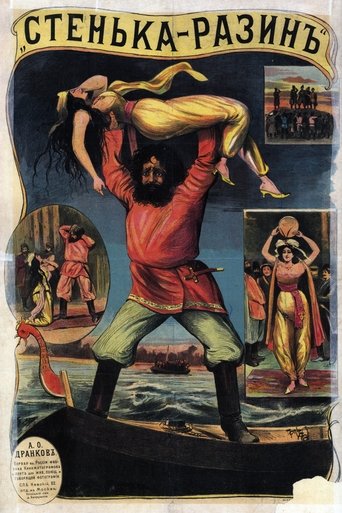
Stenka Razin (1908)
Стенька Разин
Stenka Razin is the leader of a group of outlaws who live a life of revelry and carousing along the Volga River and in the nearby forests. When Razin becomes distracted by a captured foreign princess and starts to dote on her, his men are displeased, feeling that he is neglecting them and their usual activities. Soon they come up with a plot, in the hopes of turning Razin against the princess.
- Date of release
- 1908-10-15
- TMDB
- 4.5 / 10 (23)
- Runtime
- 8m
- Genres
- Drama
- Director
- Vladimir Romashkov
Casting
- Yevgeni Petrov-Krayevsky — Stepan 'Stenka' Razin
Interesting facts
Stenka Razin, also called Free Men of the Volga, is a 1908 silent film. It is generally considered the first Russian feature film.
Production
Stenka Razin was produced by Alexander Drankov. Previously a photo journalist and official photographer for the Duma and Nicholas II, Drankov opened the first Russian film studio in 1907 and began producing documentaries in February 1908.
Drankov advertised Stenka Razin as Russia's first feature, although it was not his first attempt. He had previously attempted to film an adaption of Boris Godunov, but due to production difficulties and tensions with the actors, it was never completed. While filming Boris Godunov, Drankov frequently had to move and rebuild sets as the light changed, which led him to avoid constructing sets for Stenka Razin.
The film was originally conceived by Vasily Goncharov as part of an experimental play: the beginning and end of the play would be pre-recorded and projected on screen, while the middle would be performed live. Goncharov hired Alexander Drankov to film the opening and closing footage, but Drankov convinced Goncharov to let him film the middle scenes as well.
Stenka Razin starred Yevgeny Petrov-Krayevsky, an actor from the Petrograd People's House theater, who would later direct films for Drankov's studio. It is not known who played the princess. Little is known about the director, Vladimir Romashkov, who did not direct another picture. Mikhail Ippolitov-Ivanov wrote a score for the film, which built on the popular folk song Down Along Mother Volga.
Read on Wikipedia · Text from Wikipedia, CC BY-SA 4.0. Data from Wikidata.
Recommended
- The Young One 1960 · ★ 7.0
- Hands of Stone 2016 · ★ 6.6
- Fast Girls 2012 · ★ 6.0
- Battle of the Year 2013 · ★ 6.8
- TalhotBlond 2012 · ★ 6.3
- Girl in the Box 2016 · ★ 6.7
- Gracie 2007 · ★ 6.2
- The Coach 2018 · ★ 6.6
- American Son 2019 · ★ 6.1
- Jungleland 2020 · ★ 6.4
- Bobby Jones: Stroke of Genius 2004 · ★ 5.9
- Lorelei 2020 · ★ 6.0